Andrew Lewis, Executive General Manager, Consumer, Markets and Analytics
Australian Domestic Gas Outlook
Sheraton Grand, Hyde Park, Sydney
Good morning everyone.
First, I’d like to acknowledge the Gadigal people of the Eora Nation, the Traditional Custodians of the land on which we meet today.
I pay my respects to Elders past and present.
We recognise their continuing connection to land, waters and community.
Thank you for the opportunity to be here with you all today.
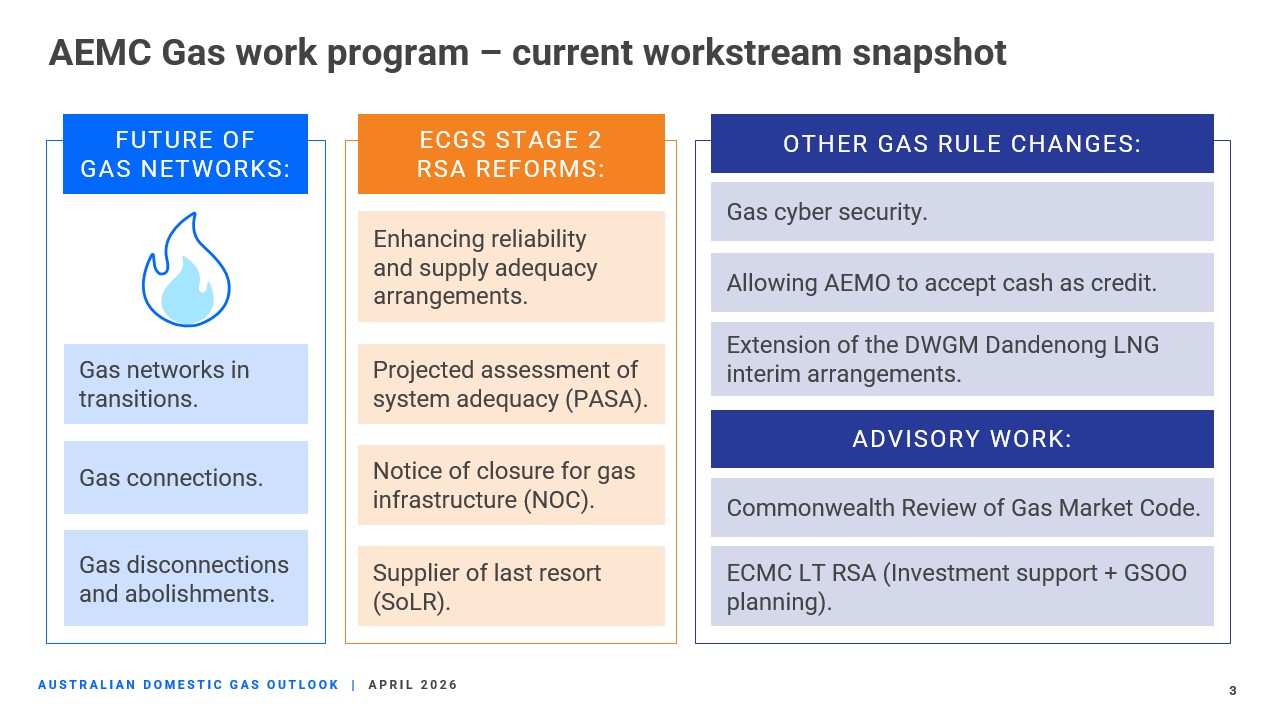
The AEMC is undertaking its largest concurrent and most significant body of work on gas in its 20 years.
Our work stream spans market design and system visibility, through to the future of gas networks, and a broad and coordinated reform program aimed at making sure the East Coast Gas System remains reliable, resilient and fit for purpose through the energy transition.
It’s why clarifying the future role of gas in the transition is one of the AEMC’s four priority areas this financial year.
I know many in this audience are highly engaged in some of this work and we greatly value your ongoing input.
Today, I’ll focus on one key part of that program – the Stage 2 gas reforms to improve the reliability and supply adequacy of the East Coast Gas System.
That sounds technical – and in some respects, it is.
But at its core, this reform program is about something much simpler, and much more important.
It’s about ensuring gas continues to be reliable, available and fit‑for‑purpose as Australia’s energy system changes – not just for today, but through a period of unprecedented transition.
Gas still matters.
It matters for households and businesses that rely on it directly.
It matters for industry.
And increasingly, it matters for electricity reliability, as gas‑powered generation plays a larger firming role alongside renewables.
The challenge we face is that the East Coast Gas System is changing faster than the frameworks that were originally designed to govern it.
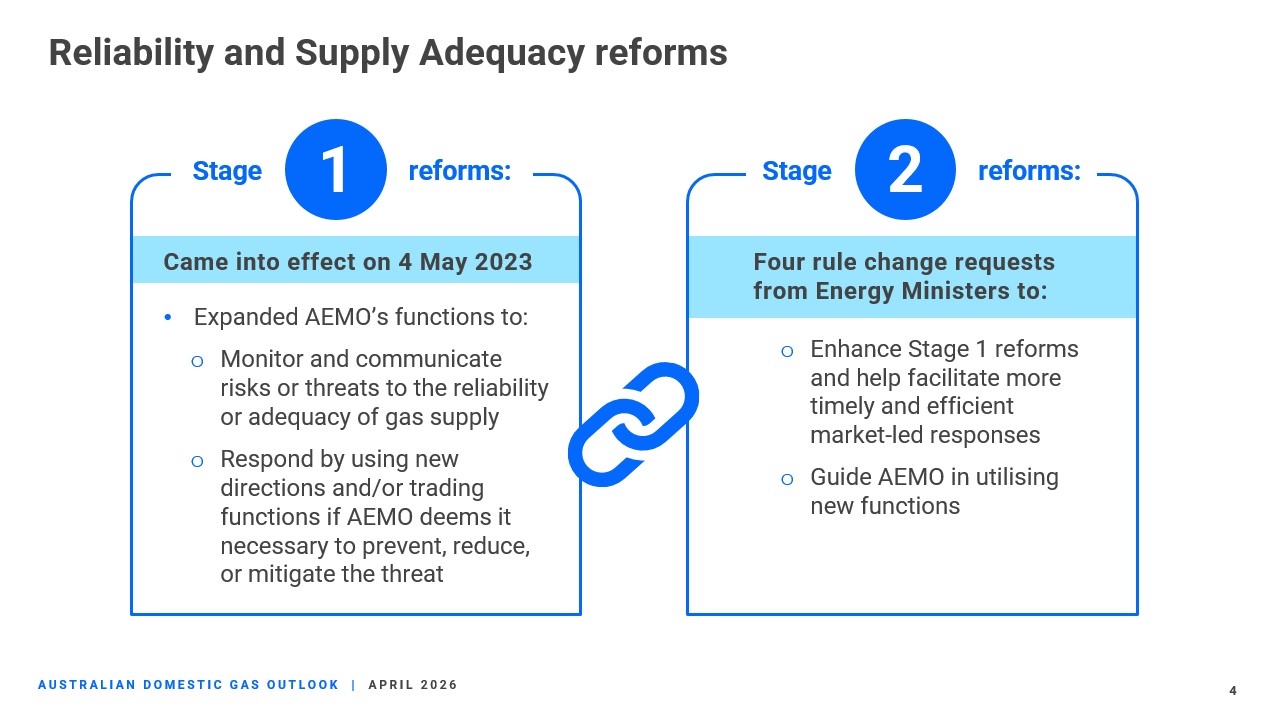
Stage 2 of the reliability and supply adequacy reforms is about closing that gap.
Today I want to do three things:
- Briefly explain why Stage 2 reforms were needed
- Walk through the key elements of the Stage 2 package and progress to date
- Reflect on what this means in practice for the market, for AEMO, and for stakeholders
To understand Stage 2, it’s worth briefly stepping back.
The existing gas market frameworks were designed for a system that was relatively stable:
- predictable demand growth
- long‑lived infrastructure
- and investment signals that unfolded over decades.
That world no longer exists.
Instead, we are seeing:
- Tighter supply–demand balances, particularly in winter
- Increased reliance on gas for electricity firming
- More uncertainty around the future role and lifespan of gas infrastructure
- Greater exposure to short‑term and medium‑term risks, not just long‑term ones
Stage 1 reforms, initiated by Energy Ministers in 2023, were an important first step.
They gave AEMO powers to manage imminent supply risks.
But Ministers were clear that Stage 1 alone was not enough.
What was missing was a coherent framework across short‑term operations, medium‑term planning, and long‑term investment signals.
Stage 2 as agreed by Ministers is designed to fill that gap – not by replacing markets, but by strengthening the information, transparency and tools that allow markets to function efficiently under stress.
It also provides greater clarity to AEMO on how to use its functions.
It improves the information available to participants in a tighter supply-demand environment.
And it helps ensure the market continues to operate effectively, even in more challenging conditions.
A critical point to emphasise is that Stage 2 is not a single reform.
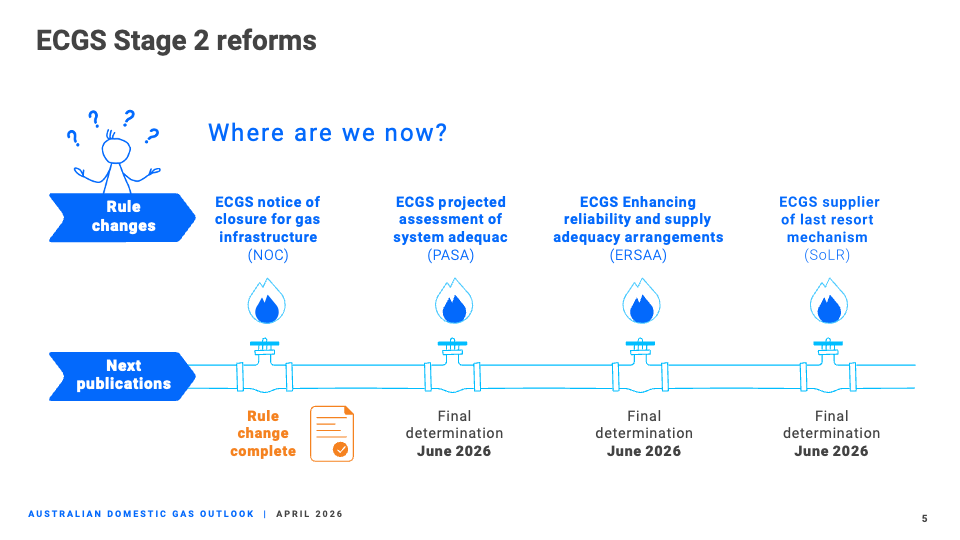
It is a package of interlocking changes, each addressing a different part of the reliability and supply adequacy challenge:
- Notice of closure of gas infrastructure – now final
- Projected Assessment of System Adequacy (PASA) – in draft
- Enhancing reliability and supply adequacy arrangements – in draft
- Supplier of Last Resort (SoLR) mechanism – in draft
Each element serves a different purpose, but together they form a more complete system.
Let me take each in turn.
1. Notice of closure – improving foresight and transparency
The first Stage 2 reform to be finalised was the notice of closure for gas infrastructure, which came into effect in September last year.
At a high level, this rule introduces a clear, formal obligation on owners of major gas infrastructure to provide advance notice when they decide to permanently close assets.
Why does that matter?
Because in a system under transition, unanticipated closures are a real reliability risk.
Historically, closures were rare and largely self‑signalled.
That assumption no longer holds.
Under the new rule:
- Operators of major production, pipeline, storage and processing facilities must notify AEMO of a decision to permanently cease supply
- Where practicable, that notice should be at least 36 months in advance
- This information is then published through existing planning reports – the GSOO and the Victorian Gas Planning Report
The design choice here is deliberate.
Rather than creating a new reporting platform, the rule embeds closure information into existing and well‑understood planning tools, minimising cost while maximising transparency.
This reform strengthens the system’s ability to anticipate change, rather than react to it.
2. PASA – closing the information gap between today and the GSOO
The second major component is the proposed Projected Assessment of System Adequacy, or PASA.
For those familiar with electricity markets, PASA is a familiar concept.
Gas, until now, has lacked an equivalent tool.
The problem is straightforward.
Between real‑time operations and the annual GSOO, there has been a material information gap – particularly over the next weeks and months, when reliability risks can crystallise quickly.
The proposed gas PASA addresses this by introducing:
- A short‑term PASA with a 7‑day horizon, updated daily
- A medium‑term PASA with a 12‑month horizon, updated weekly
These forecasts would bring together information on:
- Demand
- Supply
- Infrastructure availability
- Maintenance and outages
Importantly, PASA is designed to be principles‑based.
The rules set the minimum requirements, but allow AEMO to evolve the methodology over time through procedures and consultation, rather than constant rule changes.
Progress to date:
- A draft determination was published in mid‑2025, and the final determination is planned for June this year
- The proposed implementation is staged, with PASA expected to be operational by winter 2027
The key point here is not the forecasts themselves – it’s what they enable.
PASA provides the evidence base for better market responses, better signalling, and better decision‑making across the system.
3. Enhancing reliability and supply adequacy – better signalling, not blunt standards
The third component is the draft reform titled Enhancing reliability and supply adequacy arrangements.
This reform responds to a difficult question:
- How do we signal reliability risks clearly and proportionately, without over‑prescribing outcomes?
The Commission’s conclusion, after extensive consultation, was that a single, system‑wide gas reliability standard – similar to electricity – would not be fit for purpose.
Gas reliability risks are often:
- Localised
- Deliverability‑driven
- Highly dependent on infrastructure constraints and timing
A static standard would risk being either too blunt or too conservative – both of which could be costly to industry and gas consumers.
Instead, the draft rule proposes a tiered risk and threat signalling framework, under which AEMO would:
- Assess the likelihood and severity of forecast supply shortfalls
- Classify those risks into graduated tiers
- Communicate them transparently to the market
This approach:
- Encourages market‑led responses first
- Improves clarity about when risks are emerging
- Reduces uncertainty about when stronger interventions may be considered
The reform also:
- Enhances GSOO and VGPR reporting to include likelihood of shortfalls
- Requires AEMO to consult on and publish its forecasting methodologies
- Establishes governance arrangements for reviewing market settings via a Gas Reliability Committee
It’s worth noting here that while the proposed Committee has some similarities to the NEM’s Reliability Panel, it is designed for a different purpose and context.
Both provide a role for industry and consumer input into market settings.
But the Gas Reliability Committee is tailored to the specific characteristics of gas.
Particularly the more localised and infrastructure-driven nature of reliability risks.
Progress to date:
- A draft determination was published in February this year
- The final determination is planned for June.
This reform is about better information and better signalling, not more intervention.
4. Supplier of Last Resort – a true last resort
The final element is the proposed Supplier of Last Resort, or SoLR, mechanism.
This reform provides guardrails around how AEMO would use its existing trading function in extreme circumstances.
The core principle is simple:
- The market responds first
- AEMO intervenes only when necessary, and only as a last resort
The SoLR mechanism:
- Allows AEMO to contract for supply‑side and demand‑side responses
- Requires competitive tendering - and would not see AEMO participating directly in the markets it operates.
- Links activation to the highest tier of the risk‑signalling framework
- Sets clear thresholds before SoLR can be used
- Includes price limits and cost recovery arrangements
- Strengthens transparency and accountability requirements
What this reform does not do is replace the market.
It also does not change AEMO’s directions powers or any Ministerial emergency powers.
Instead, it provides:
- Certainty about when and how last‑resort tools may be used
- Confidence that interventions will be proportionate and disciplined
- Protection against ad‑hoc or opaque decision‑making under pressure
Progress to date:
- A draft determination was also published in February
- The final determination is planned for June.
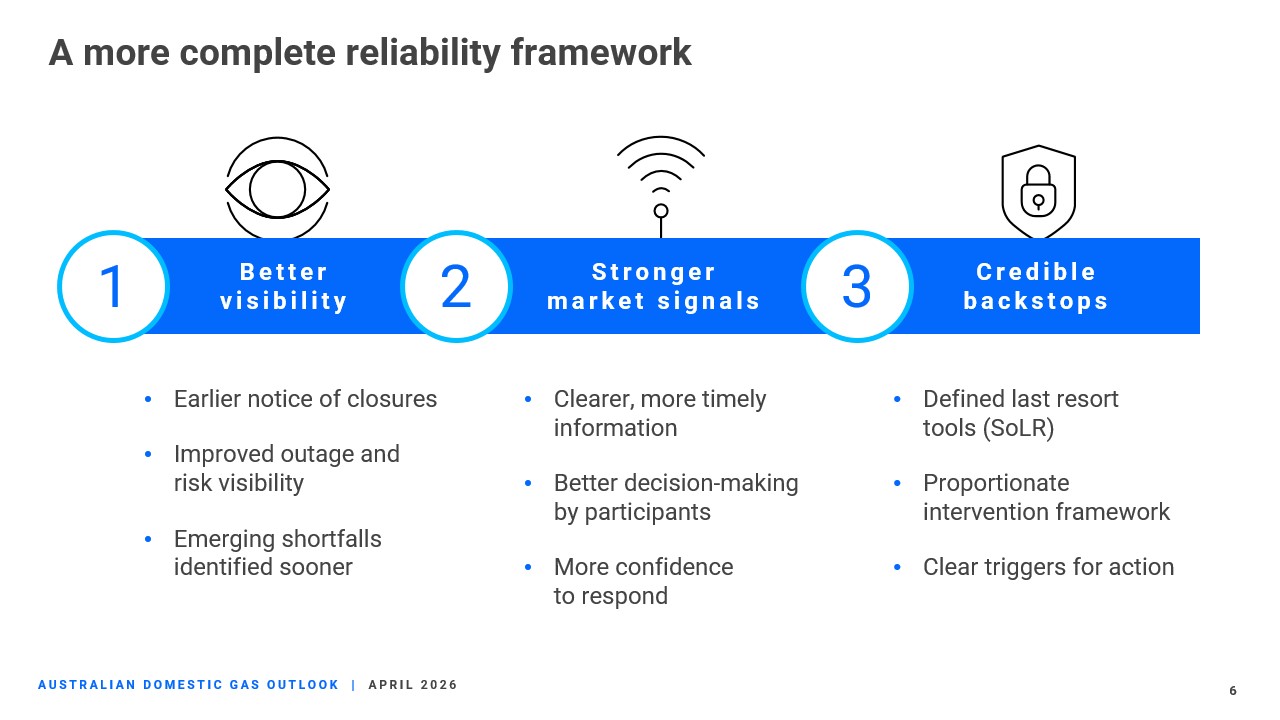
Taken together, Stage 2 delivers three major improvements.
First, it improves visibility.
- Closures, outages, risks and emerging shortfalls are identified earlier and more clearly.
Second, it strengthens market signals.
- Participants can respond to risks with better information and greater confidence.
Third, it provides credible backstops.
- AEMO has tools that are clearly defined, proportionate, and last‑resort in nature.
Importantly, Stage 2 does this without over‑engineering the system.
The reforms are:
- Largely information‑based
- Principles‑driven rather than prescriptive
- Designed to evolve as the system continues to change
A consistent thread throughout this work has been pragmatism.
We’ve listened carefully to producers, pipeline owners, investors, and of course, AEMO, to find solutions that are simpler, lower cost and still deliver the intended outcomes.
We don’t need a Swiss Army Knife, if one tool can do the job!
This approach is demonstrated in the Commission’s draft decision to not make a reliability standard.
The evidence from industry was clear: it would add great complexity and ongoing costs without delivering at least equivalent benefits.
It’s also reflected in the final Notice of Closure rule.
We took a proportionate approach, recognising that closures are expected to be relatively infrequent,
And we’ve avoided unnecessary system and reporting costs by using established planning tools to deliver the required transparency.
You can see it again in our Supplier of Last Resort design - providing clear guardrails for AEMO, without creating additional complexity in how those tools are applied.
Of course, not everyone will get everything they want.
But we are committed to testing ideas rigorously to find and refine the most effective and practical solutions that address the problems governments and industry participants are concerned about.
I’ll finish with three brief reflections.
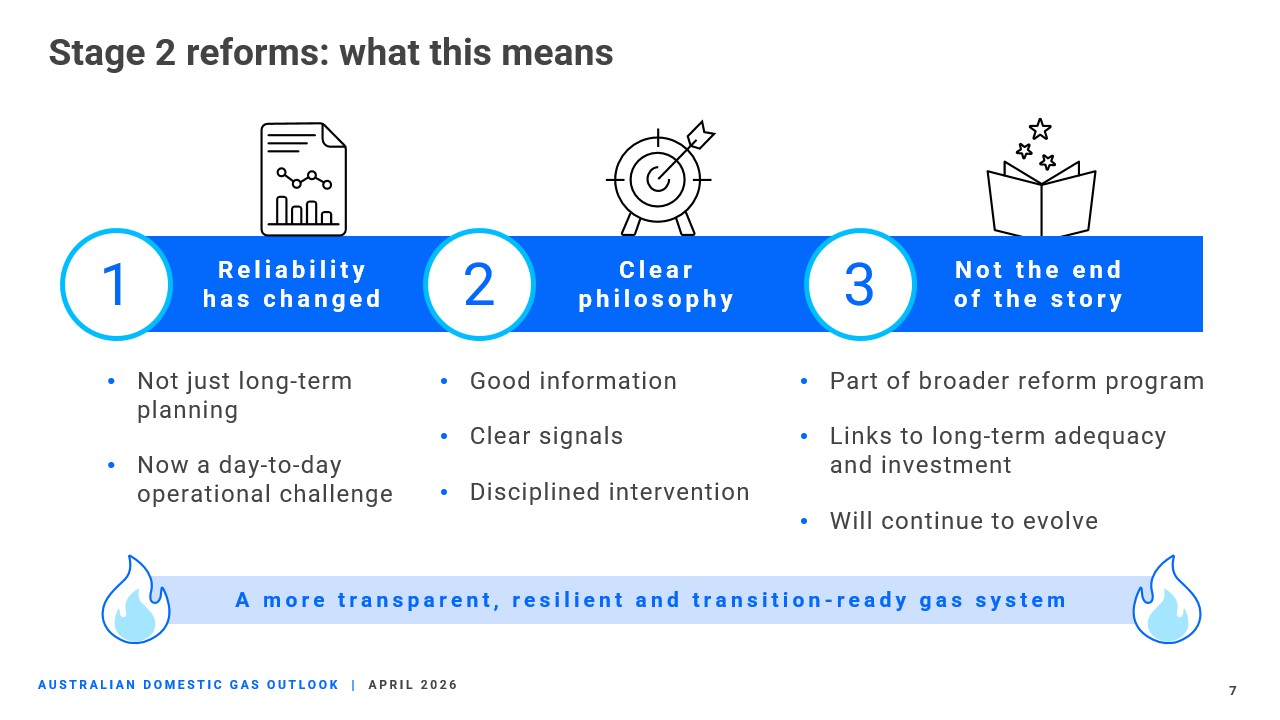
First, Stage 2 recognises that reliability is not just a long‑term planning problem.
It is a day‑to‑day operational challenge in a system under transition.
Second, the reforms are grounded in a simple philosophy:
markets work best when information is good, signals are clear, and intervention is disciplined.
And third, this is not the end of the story.
Stage 2 sits alongside broader reforms – including work on longer‑term supply adequacy and investment – and will continue to evolve as conditions change:
As demand patterns shift. As electrification progresses. And as the role of gas continues to be reshaped.
But it is a significant step forward.
It gives the East Coast Gas System a framework that is more transparent, more resilient, and better suited to the realities of the energy transition.
Thank you.