Sally McMahon, Commissioner
ENA Regulation Seminar
State Library of Queensland | Brisbane, Australia
Good afternoon.
Let me first acknowledge the traditional custodians of the land on which we meet today. The Jagera and Turrbal people on Meanjin.
I pay my respects to their elders, past and present, and I extend that respect to all Aboriginal and Torres Strait Islander peoples with us today.
Thank you to the ENA for having me here today. It is great to be back in Brisbane. And always a pleasure to see so many familiar faces.
We are all trying to plan and build an energy system that is fit for the future. We each have a view about what that future will look like.
But as an economist, I am realistic about forecasts: they are either lucky or wrong.

That is not a reason to avoid planning. Indeed, it makes it even more important. A plan makes assumptions visible, keeps options open and allows us to change course when the world changes around us.
What we can say with confidence is that the future will be different from the past – and unless we are lucky, different from what we forecast.
My focus today is on the economic regulation of network businesses amid uncertainty and change. The current framework has served us well, but it was built around boundaries between competitive services and natural-monopoly network services at a particular point in time.
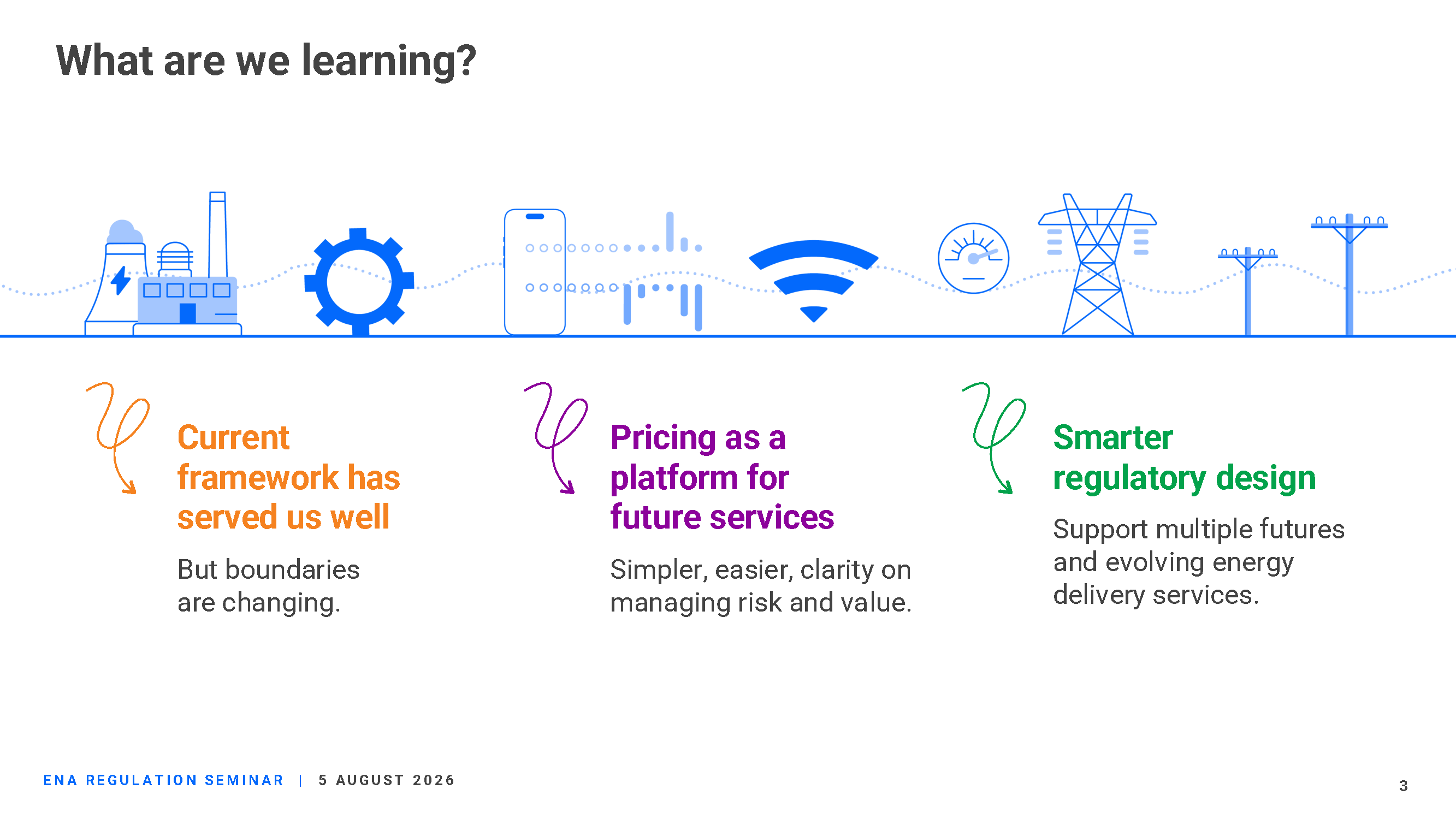
CER, storage, digital technologies, changing economics and consumer choices, and policy are testing the boundaries of energy delivery services and the incentives that support them.
At the AEMC, we have already started testing the regulatory framework.
In our pricing review, we wanted to look at how pricing will serve future customers. We found that, without change, it could not.
Left untouched, network costs would grow, and the divide between the haves and the have-nots would worsen.
We concluded that competition remains central to delivering better outcomes for customers, but customers need better tools, stronger protections when harm emerges, and clearer accountability for those who manage complexity and risk.
Network businesses have an important role in rewarding use that lowers system costs and sharing common costs fairly.
Done well, this should result in CER being utilised where it is most valuable to the system and individuals, and we avoid limits on the use of CER.
So these changes provide a platform for multiple energy futures. But we can do more.
We need regulatory frameworks that are flexible enough to withstand shocks and support evolving energy delivery services; strong enough to sustain investment amid uncertainty; and disciplined enough to keep the main game in sight — better outcomes for consumers.
The central question is whether regulation can stay disciplined on consumer outcomes while becoming more agile about uncertainty, investment and risk.
My answer is yes — but only if we make assumptions visible, allocate risks and reward deliberately, and judge choices by their effect on whole-system costs over time and for future customers.
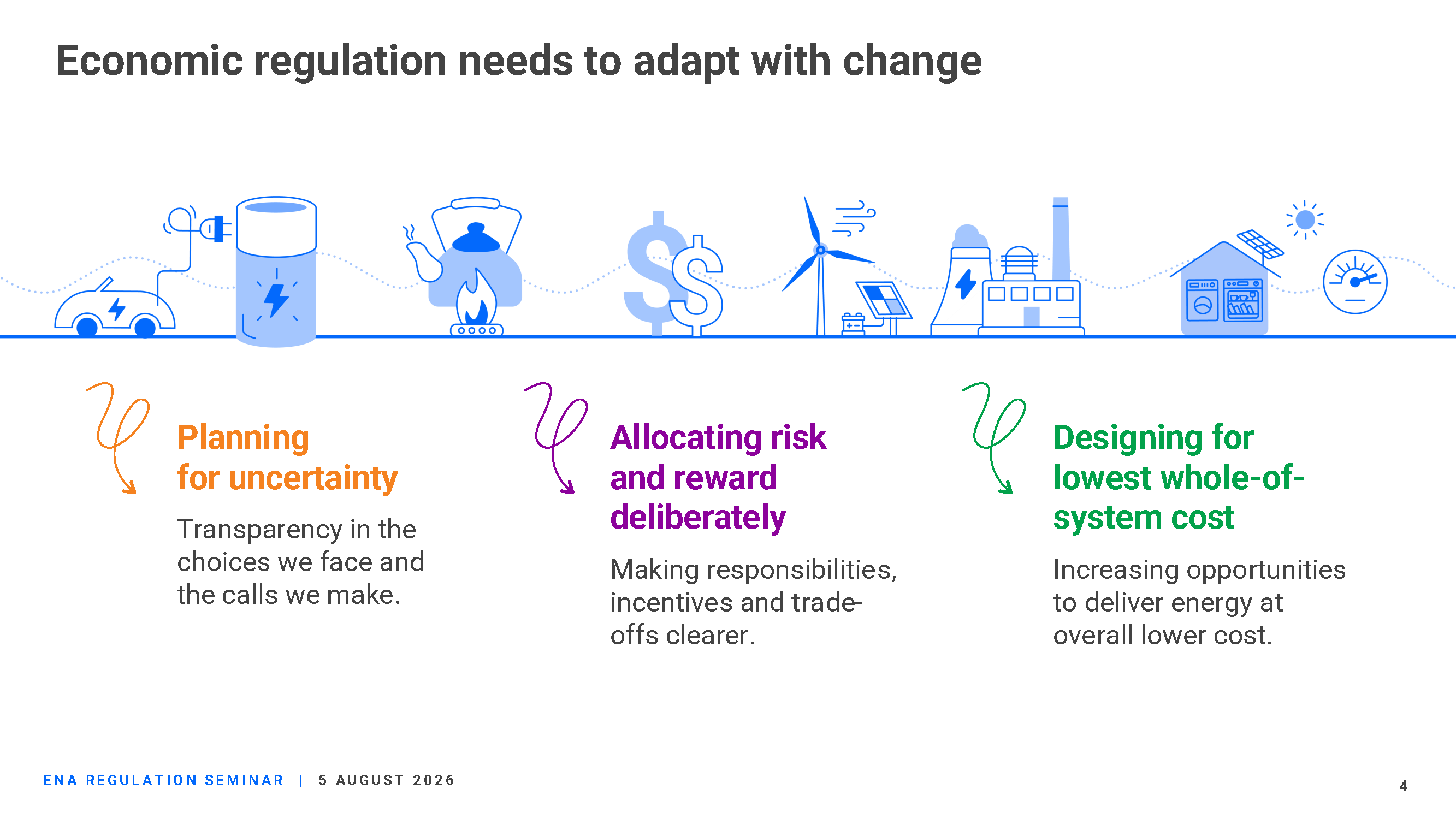
Today, I will run through three ideas: planning for uncertainty, allocating risk and reward deliberately, and designing regulation for the lowest whole of system cost.
Those three ideas are connected. Better planning reveals the choices we face. Better risk allocation makes those choices honest. And a whole-system cost lens helps ensure the choices we make serve consumers’ long-term interests.
Planning for uncertainty requires having a plan that makes assumptions visible, guides action, and gives us permission to change course when those assumptions no longer hold.
It also holds us to account. When assumptions change, we need to change with them and bring others with us.
We are reviewing and revising our work as stewards of the national rules.
Our national energy objectives remain relevant and desirable, but we have a new objective and our underpinning assumptions have changed.
The boundaries between monopoly services and competition are moving, as is the competitive rivalry and interaction between gas and electricity due to changing economics, technology and policy.
Gas
Gas networks are where these assumptions are changing most sharply. The regulatory framework for gas assumed demand would grow and that consumers would continue to prefer gas over electricity for many uses.
Those assumptions no longer hold.
If demand declines, fixed costs will be recovered from a smaller customer base, putting upward pressure on bills and potentially accelerating the departure of customers with the means to electrify. That would leave remaining costs with renters, apartment dwellers, lower-income households and small businesses. That is not an orderly, equitable or desirable transition.
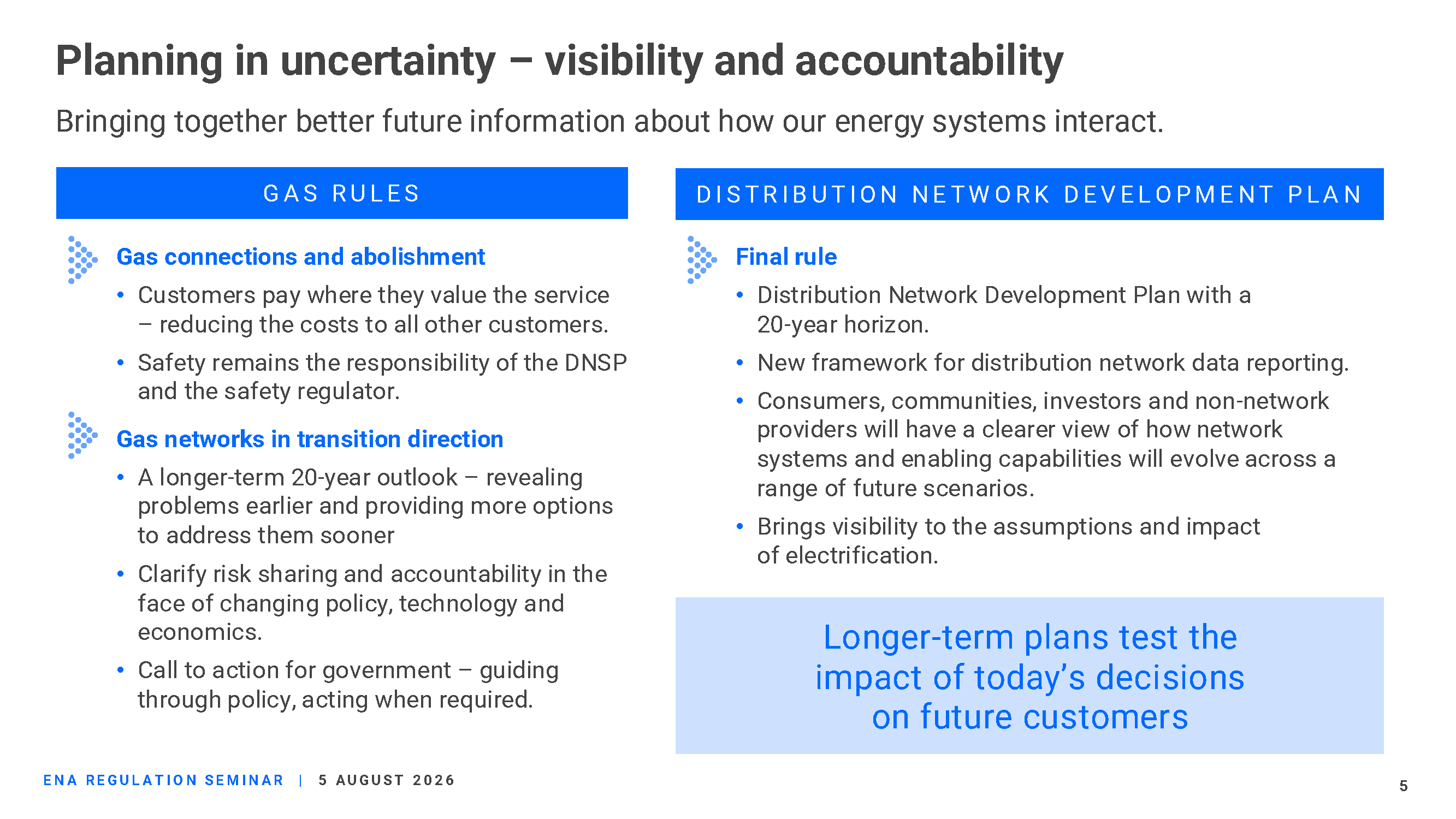
Our recent gas rules start to address this problem. New customers will pay the full cost of connecting to the network, which gives consumers clearer information to support decisions about their energy options and avoids unnecessary growth in the regulated asset base.
Our abolishment rules also make sure customer choices do not shift costs unnecessarily to others, while allowing safety-related decisions to be left to safety regulators with these costs shared where that is the right outcome.
The rules are designed to stop the asset base growing unnecessarily, reduce the problem as much as we can, and to stop us pushing the hard decisions and a bigger problem too far into the future.
Our gas networks in transition direction is designed to reveal the problem earlier and allocate accountability more clearly.
Gas distribution networks will provide a 20-year outlook for their systems, expected demand, services and customer impacts. This does not remove uncertainty, but it makes responses to uncertainty more deliberate, transparent and accountable.
A longer-term outlook helps surface those risks earlier – while more options are still available.
We are not pretending the rules can solve every stranding risk. Some choices and management of risk will need to be guided by government policy and action. But the rules can stop the problem growing unnecessarily, reveal risks earlier, and make businesses and regulators identify where assumptions differ, the future they are planning for and explain the consequences of today’s decisions for future customers.
Prices to gas customers are expected to be constrained by customer choices and options. The fundamental assumption that gas competes with electricity remains; gas network investors will continue to have no guarantee of cost recovery and will remain responsible for managing this risk as the future becomes clearer.
That is the platform we think is needed.
Electricity distribution planning
Electricity distribution networks face the same need for clearer long-term planning.
Consumer energy resources, electrification and new technologies are changing power flows, demand patterns and local network needs. Sometimes the efficient answer will be more network capacity. Other times it may be a community battery, flexible demand, a virtual power plant or another non-network solution. Better information helps reveal those choices earlier, and may show where investment can be deferred or avoided.
Our rule change helps distribution network planning and reporting evolve with these changes. It explicitly recognises enabling capabilities, not just assets or networks.
DNSPs will prepare five-yearly plans with a 20-year outlook, annual updates, and more consistent distribution network data reporting — including greater visibility of the low-voltage system where much of the change associated with consumer energy resources and electrification is occurring.
Consumers, communities, investors and non-network providers will have a clearer view of how network systems expect to evolve and how decisions at the distribution level interact with transmission planning and the broader system.
Gas and electricity outlooks need to speak to each other.
A household leaving gas does not disappear from the energy system; it appears elsewhere — in electricity demand, local network requirements, peak loads and investment patterns. 20 year plans for gas and electricity will support this discussion.
Early visibility will provide more time to act and consider more options to manage risk and consequences.
Once those risks are visible, the next question is who should bear them.
Responsibility should sit with those best placed to manage the risk at lowest cost. As technology, demand, markets and economics change, we need to test whether the regulatory framework still captures the right risks and compensates them in the right way.
Changing risks and the increasing diversity of energy delivery services also require us to test the strength and focus of incentives to drive efficient and timely investment and performance.
If we get it right, our energy delivery businesses will only earn more than the regulated return where they deliver better outcomes for consumers than planned.
ENRR
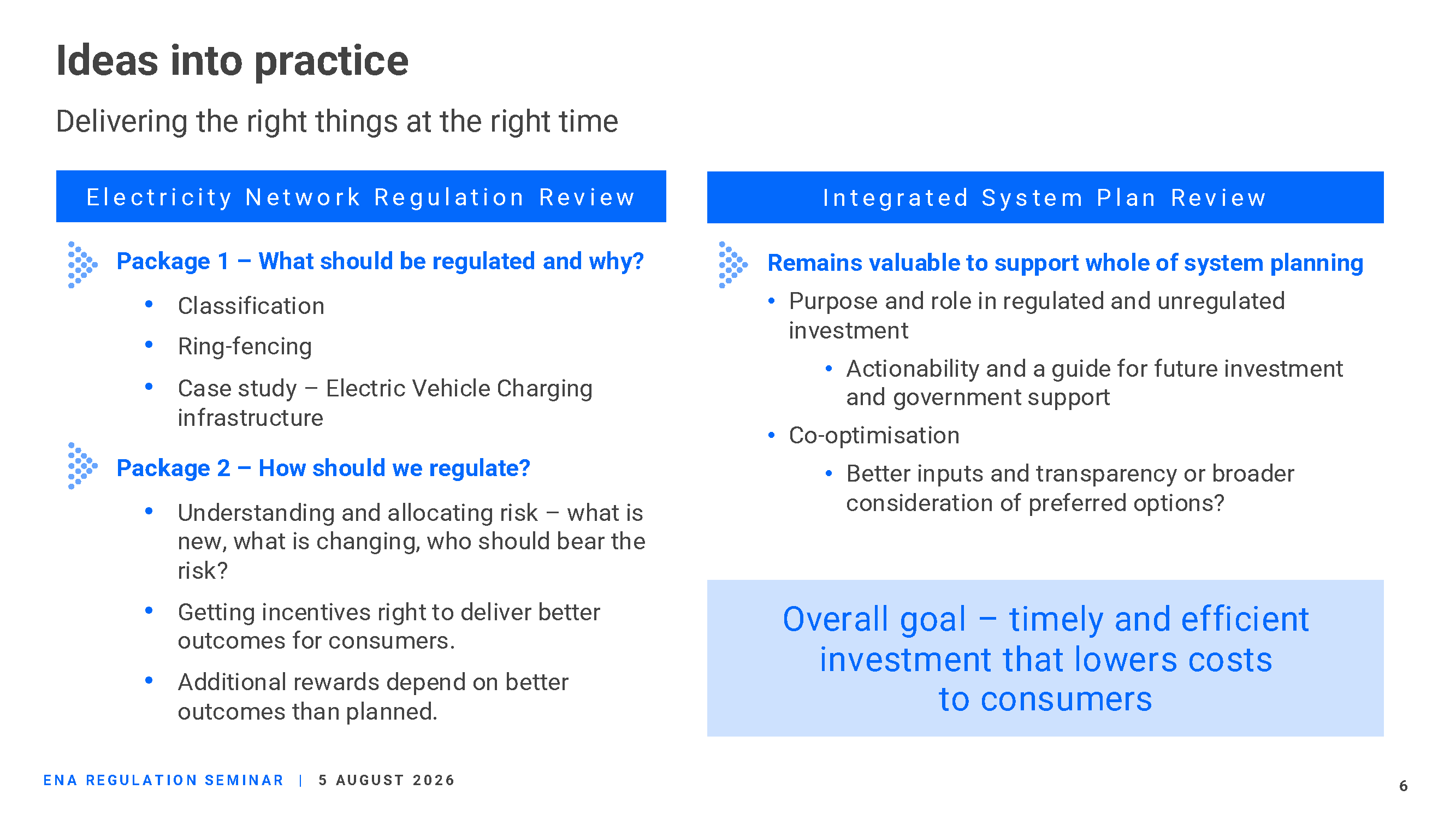
That is why we have commenced a review of electricity network regulation. New technologies, new business models and changing patterns of energy use are testing boundaries and the sharpness of incentives to reward the right outcomes for consumers.
Before deciding how networks should be rewarded for delivering future services, we need to be clear about which services should be regulated, which should remain competitively provided, and who should pay for them.
The first phase of our Electricity Network Regulation Review looks at where the boundary should sit between regulated monopoly services and competitive provision, and whether service-classification and ring-fencing arrangements remain fit for the future.
Service classification affects how costs and utilisation risks are recovered, and whether they are borne by all network customers or by users of the service.
Ring-fencing aims to ensure that regulated revenues do not fund activities in competitive markets and regulated businesses provide services on a non-discriminatory basis.
Electric vehicle charging is testing this framework. More charging infrastructure can support emissions reduction, lower energy wallets and more efficient network utilisation.
We hear that there are problems with the process and charges for connecting electric vehicle charging infrastructure that might be dampening the rollout. We can investigate and fix this.
Electricity network service providers may be able to deliver certain infrastructure efficiently and accountably and better facilitate competition in charge point operation and energy supply. But we need to test this model.
If it becomes essential infrastructure, the regulatory question is not simply whether it should be built. It is how to deliver access at lowest cost, who should pay, and whether costs should fall on network customers generally or only on users of the service.
If EVCI becomes an essential service in our future, we need to understand the risk of simply shifting a service with monopoly characteristics to a different provider that is not subject to price or service regulation or required to provide access to third parties.
This is why we need to be clear about which service is being regulated, the markets that may be affected and how, and the consequences for competition and equity.
Can the regulatory model better support efficiency, access and performance and avoid further growth in the divide between the haves and have-nots?
The second stage of the ENRR asks how regulated services should be regulated. This stage will look at how networks are compensated, incentivised and held accountable for decisions and delivery. This will include understanding new and evolving risks and the need for more, less or changes in incentive schemes and the interactions between them.
Which risks can networks reasonably manage and do so at lower cost? Can we be confident that consumers do not become the default bearer of risks that other parties are better placed to manage? How should network systems be rewarded for managing risks, efficient investment and performance so that we can be confident in better outcomes for consumers?
Accountability for regulatory design sits with us.
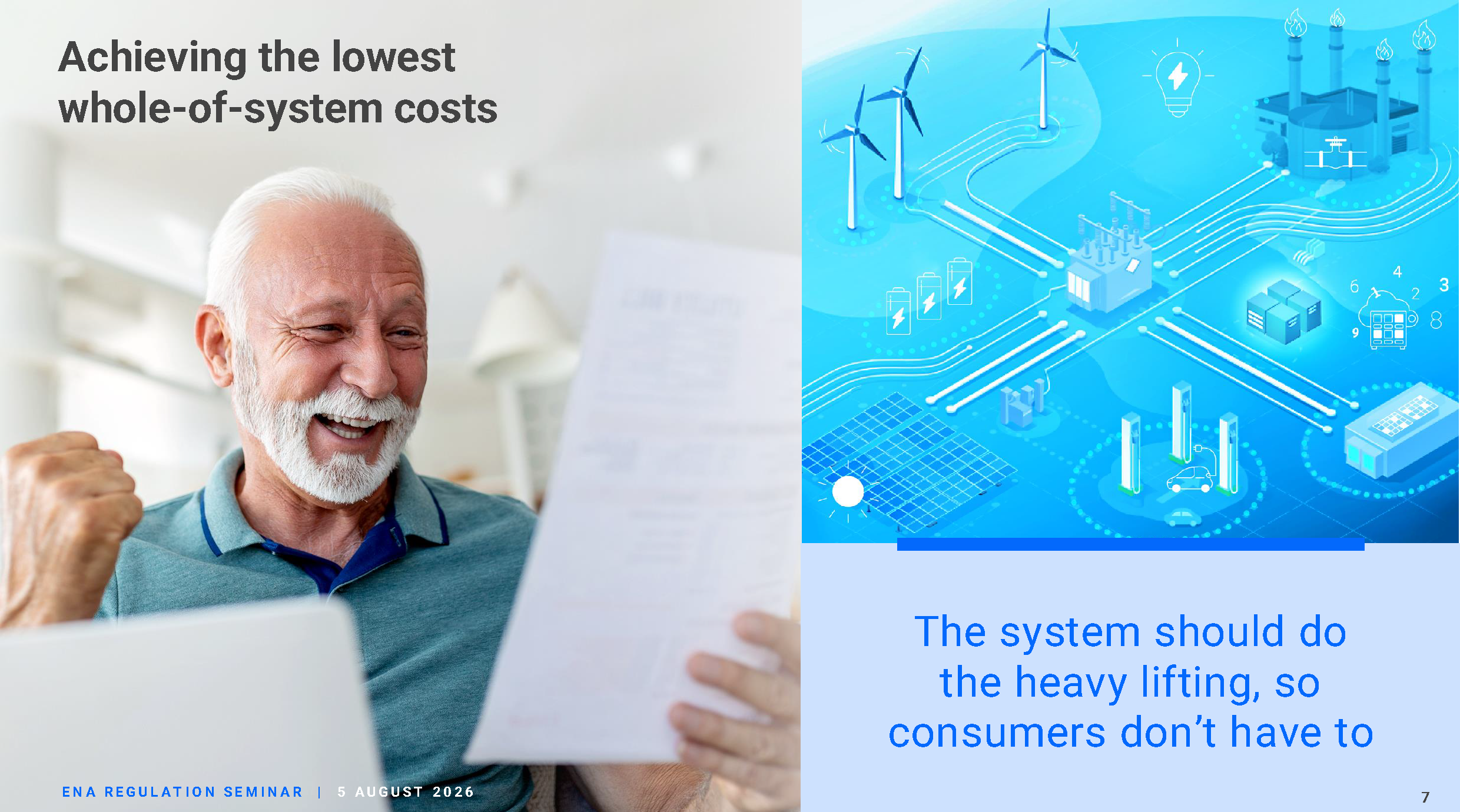
That leads to the third idea: designing regulation for the lowest cost across the whole system. The old task was to minimise the cost of network services and rely on competition to minimise costs in generation and retail. But as technology and economics change, the lowest-cost answer may not sit neatly inside one part of this traditional supply chain. It may involve more network or using new technologies, flexible demand or non-network solutions to reduce costs elsewhere in the system.
This might mean providing incentives for innovation and enabling energy supply solutions that provide an overall lower cost.
The UK already includes strong incentives for innovation and is becoming more comfortable with efficient anticipatory investment. That does not mean giving networks a blank cheque. What it means is recognising the value of innovation and the cost of delay.
More network investment sooner may support additional lower-cost renewable energy supply, reduce congestion costs and avoid significant increases in the cost of doing the same work later in a rising cost environment.
But gas, electricity, transmission, distribution, consumer energy resources, storage, flexible demand and large loads all interact.
Electrification may reduce a household’s total energy costs, while increasing electricity network requirements and costs for customers who remain on gas.
A network investment may address a constraint, but flexible demand or a non-network solution may do so at lower overall cost.
The question is whether we can better balance prudency with timely delivery and flexibility to deliver overall lower cost.
A framework focused on lowest overall cost also needs neutrality between capital and operating expenditure. If local generation, storage, flexible demand or another non-network service can substitute for traditional reinforcement, the framework should not prefer or deter one option simply because of how it is accounted for. The test should be the lowest long-term cost of delivering the service consumers need.
But what could and would that incentive look like so that it rewards the right things in a way that customers benefit over time and those rewards are only paid when lower costs are demonstrated?
This is central to our reviews of electricity network regulation and the ISP framework.
The ISP remains valuable because it supports coordinated whole-system planning and influences investment in two ways: directly, through regulated transmission projects under the actionability framework; and indirectly, by providing a common evidence base and more confidence for investment in generation, competitive infrastructure and government support. But the environment around it has changed.
Distribution networks, CER, storage, flexible demand and new large loads increasingly shape what the system needs, and where and when it needs it. We have gone from lots of big generation connected by big infrastructure to include millions of smaller generation opportunities saturating the distribution network.
The options and substitutability are growing.
Last month we made no rule on how the ISP treats jurisdictional emissions reduction targets and policies. It is not AEMO’s role to cost jurisdictional policies and the ISP becomes meaningless if we assume it need not meet the national electricity objectives.
A few weeks ago, we released a discussion paper as the next step in our ISP review.
Key considerations in that review are the purpose and role of the ISP in regulated and unregulated investment, actionability, co-optimisation, and interaction with jurisdictional schemes. We are also considering modelling, information, deliverability, and governance.
Co-optimisation is more than feeding better inputs into the ISP. Inputs reflect information about distribution networks, CER, storage, flexible demand, large loads and gas. Co-optimisation tests the trade-offs among those options — asking whether investment in one part of the system can reduce, defer or avoid investment elsewhere.
A practical lens must be adopted here – given the millions of individual consumer decisions, we must ask can it be done as well as should it be done?
The overall test is whether the framework supports more coordinated, timely and efficient investment, and ultimately lowers costs for consumers.
Let me conclude with three points.
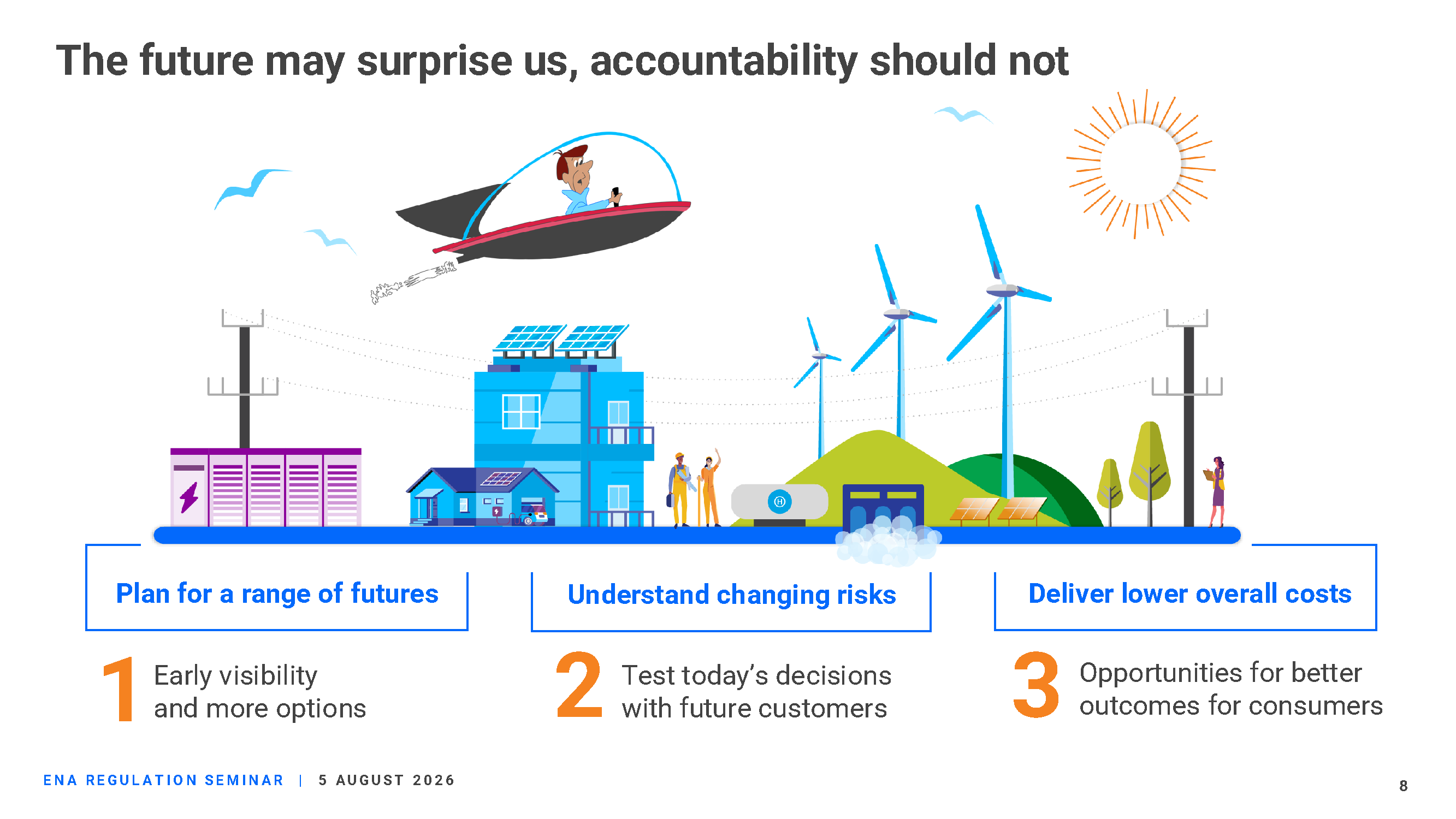
First, uncertainty is not a reason to wait; it is a reason to make assumptions visible, reveal risks early, preserve options for a range of futures while they still exist, and have courage to act.
Second, risk and reward should be allocated deliberately and result in lower costs. Mitigating these risks must include testing our decisions today for impacts on future customers.
Third, we must design to achieve overall lower costs to customers, providing flexibility to unlock opportunities to deliver better outcomes and reward choices that lower costs for consumers across the whole system over time.
The energy sector was built around long-lived assets, centralised systems and assumptions that changed slowly. In that environment, shorter plans and slower updates to assumptions carried less risk.
The next phase will be shaped by faster technology, more consumer choice and greater uncertainty. We must hold ourselves to account to be quicker and sharper in adjusting our assumptions and acting.
Our task is not to remove uncertainty. It is to build a system that is flexible, resilient to shocks and clear on accountability for the long-term interests of consumers.
The future may surprise us. Accountability should not.
Thank you.