Lana Stockman, Commissioner, Australian Energy Market Commission
Data Centre Show
Swissotel, Sydney
Before I begin, I want to acknowledge the Traditional Custodians of the land we are meeting on today - the Gadigal people of the Eora Nation - and pay my respects to their Elders past and present. I extend that respect to all Aboriginal and Torres Strait Islander people here today.
As someone from Aotearoa New Zealand, I would like to share a small piece of my own culture with you.
There's a Māori proverb that has really shaped how I think about this work. In English, it means: "I walk backwards into the future with my eyes fixed on my past."
In te reo Māori, it is: Kia whakatōmuri te haere whakamua.
It is not about being stuck looking backwards. It is about moving forward with what we have already learned.
That is exactly the lens I want to bring to data centres today.
Good morning. Thank you for having me open with a key note on day two.
I want to start with a confession: I do not think data centres are the story here.
I think the story is a much older one, and data centres are simply the latest chapter in it.
Let me tell you about the first data centre I ever saw, though I did not know that is what it was at the time.
I was about seven or eight, growing up on a military base. Just off the base sat this enormous concrete building — properly brutalist, built sometime in the sixties or seventies. My parents told me it was "the government computer" — and, as I remember it, that it held all the records for parking tickets and fines. I have no idea if that part's actually true. But it was fenced off, hardly a car ever came or went, and to an eight-year-old, it was the single most mysterious building in the world.
I think about that a lot now. Whatever that building actually held, the computing power inside it would fit on the phone. But the mystery has not entirely gone away. Data centres still carry a bit of that same aura — something important happening behind a wall, that most people never get to see inside.
Which is part of why conversations like this one matter: pulling back the curtain a little on what is actually going on inside these buildings, and what it means for the electricity system all of us depend on.
Before I talk about data centres, I want to draw three lessons from changes the electricity system has already absorbed.
The first comes from air conditioning: new demand can change the system faster than expected.
As air conditioning became commonplace, it transformed the shape of electricity demand. Thousands of individual decisions combined to create enormous peaks on the hottest days, and networks had to adapt.
The lesson was that it is not simply the amount of new demand that matters. It is when it arrives, where it arrives and how concentrated it is.
The second comes from wind power: technical challenges that look formidable today can become manageable tomorrow.
I remember the early wind debate in New Zealand. The concerns around intermittency, forecasting and system stability were genuine.
But technology improved. Forecasting improved. Operating practices and market arrangements evolved. What was once regarded as difficult to integrate became a normal part of operating the system.
And the third comes from rooftop solar: sometimes the system has to adapt not just to a new technology, but to a new kind of participant.
Millions of Australian households became generators as well as consumers. That challenged forecasting, network operations and some very basic assumptions about the relationship between the system and the customer.
The rules and the system had to evolve with them.
Those three experiences give us three useful lessons for data centres.
Plan for the characteristics of the demand, not simply its size.
Do not mistake a technical integration challenge for an insurmountable one.
And make sure the regulatory framework evolves as the participants in the system evolve.
That is why I do not see data centres as an entirely new kind of problem.
They are bigger, faster and more concentrated than the changes that came before. But the pattern is familiar.
The system can adapt.
The question is whether we shape that adaptation deliberately, or whether we let it shape us.
I want to be honest about what happens when that question gets answered badly. A few years ago, Dublin effectively imposed a moratorium on new data centre connections, because energy security concerns had built up faster than the regulatory settings could respond to them.
Whatever you think about the specifics of that case, the broader lesson is the one that matters here: when the framework lags the growth, the eventual correction maybe far more disruptive - for investors, for operators, for everyone – than what proportionate, timely rules would have been. The bigger cost is not regulation. It is regulation falling behind.
And I want to name something else, because everyone in this room will have felt it. The temperature of this conversation is changing- even in the few weeks since I first sat down to write this speech.
In July, YouGov polled sixteen hundred Australians for the Climate Council. Eighty-two per cent said governments should require new data centres to fund renewable generation and storage matching what they consume. Sixty-seven per cent thought data centres risked pushing up power bills. And less than half were convinced this industry would be good for the economy. Sit with that last one. On those numbers, this sector is more widely believed to raise people's bills than to grow the economy.
The picture, of course, is more complicated than that. Your own industry association points out that members already offset around seventy per cent of their energy use voluntarily, that you already pay for your connection costs, and that the sector has committed more than $3 billion to grid investment since 2020. Those are not small numbers. They are also not well known.
That gap - between what this sector is actually doing and what the public believes it is doing - is a commercial risk, not just a reputational one. Social licence is not a communications problem; it is an operating condition. And a good regulatory framework is, among other things, a way of making what you already do visible, verifiable, and therefore defensible.
So what does shaping this deliberately actually mean?
For me, it comes down to three things.
We need to be able to plan for the demand.
We need to make sure growth does not leave existing consumers carrying costs and risks they did not create.
And we need a connection framework that manages the technical challenges while giving good projects a clearer and more certain pathway through the system.
That is the lens I would put over the work now underway.
First, we need to be able to plan for the demand.
That sounds obvious, but with data centres it is more complicated than it sounds.
AEMO's analysis shows that actual data centre demand can sit well below installed or contracted capacity, because facilities may connect for their maximum potential load and then ramp up over a number of years.
So a connection queue is not a demand forecast.
That matters in both directions.
If we underestimate the growth, we risk being caught without the generation and network capacity to support it.
But if we simply plan around headline connection numbers, we risk building infrastructure that consumers pay for but ultimately do not need.
That is why better visibility is so important.
One of the measures we recommended to Energy Ministers is registration of large data centres with AEMO. That gives the system operator better information about what is connecting and how that demand is likely to develop.
It may sound like an administrative measure. In reality, good information is fundamental to good investment decisions.
Second, growth needs to bring the investment that supports it.
The starting point for the AEMC is simple: consumers cannot be left worse off.
That does not mean stopping new demand. It means making sure that as new demand enters the system, the energy, capacity and network investment needed to support it comes with it.
That principle sits behind several pieces of work now underway.
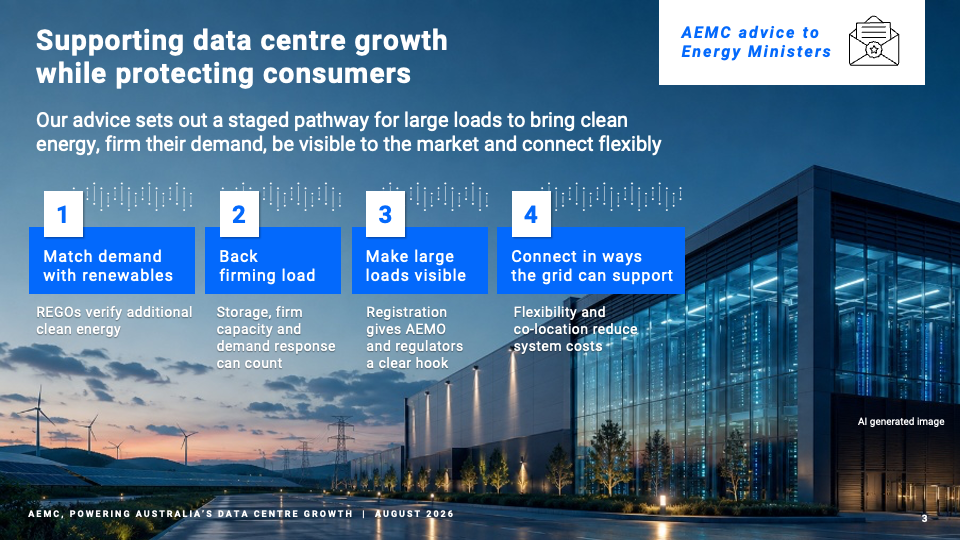
Energy Ministers asked us for advice on how data centres could fully offset their demand. We recommended a package that would bring forward new renewable generation and ensure that new data centre load is supported by firm capacity, whether through contracting, storage or demand flexibility.
There is also work underway on network cost recovery. The principle there is equally straightforward: where a very large new connection triggers a network investment, we need to think carefully about who bears the cost and the risk if the expected demand does not ultimately materialise.
These are different reforms, but they are addressing the same fundamental question: how do we capture the benefits of new investment without shifting unreasonable costs or risks onto other electricity consumers?
And third, we need to make connection work better.
This is where I think there is a real opportunity for the industry.
Data centres are large, concentrated and technically complex loads. But they are not all the same.
Their size, technology, location and ability to be flexible can vary enormously.
So a framework that treats every large load identically is not necessarily a good framework. It can simply be a blunt one.
Our work on access standards for large inverter-based loads is about getting those technical requirements right upfront: clearer standards, appropriate ride-through requirements, better information for AEMO and networks, and greater alignment with international approaches where that makes sense.
But connection should not only be about managing risk.
It can also create incentives for better outcomes.
A data centre that can offer flexibility, locate where there is available network capacity, connect alongside new firming, or co-locate with generation and storage may be able to reduce the costs it imposes on the wider system.
The regulatory framework should recognise that.
Because there is a bargain available here.
If a project can help solve some of the problems its connection creates, the system should be able to recognise that through greater speed and certainty.
And speed and certainty are things I know this industry values.
That is the direction behind the package of measures we have put to Ministers.
It is not a moratorium. And it is not a one-size-fits-all prescription.
The objective is to allow growth to proceed, while making sure the generation, firming, network capacity and system capability needed to support it develop alongside it.
There is still important design work to do.
Energy Ministers considered our advice in July and we published it earlier this month. Not every jurisdiction has taken exactly the same position, and there is detail still to be worked through across governments, market bodies and industry.
The implementation is also intended to be staged. This is not a cliff edge.
But some of the decisions that will matter most to your businesses will be made well before the final measures take effect.
And that brings me to the other side of this story.
Because everything I have described so far could sound like a speech about managing the risks created by data centres.
I do not think that is the whole opportunity.
If we get the design and sequencing right, data centres could become not simply a load the electricity system has to accommodate, but an investment that helps strengthen it.
And we have seen this trajectory before. Last year, the AEMC finalised a comprehensive overhaul of the access standards for inverter-based renewables, including wind and solar.
That reform made the connection process faster and less costly, by giving proponents more certainty upfront and cutting down the protracted technical negotiations that used to slow every project down. Wind and solar went from being the thing the system worried about integrating to being core, trusted parts of how the system runs. That is the trajectory I expect for large flexible loads too, if we do the work now rather than later.
If the framework for data centres is well designed, well sequenced and properly integrated into the electricity system, there are some significant potential benefits.
First, data centres can help bring forward new renewable generation. More renewable generation means a more diverse generation mix, reducing our exposure to individual fuel risks and strengthening the resilience of the electricity system.
Second, if data centres are connected in the right locations, and our transmission and distribution systems are planned well around that new demand, they can improve network utilisation. Better utilisation of the network can reduce average costs across the system, benefiting all consumers.
Third, bringing new technologies such as data centres into the system can help accelerate other innovation. New types of demand create new commercial opportunities and incentives for technologies such as storage, demand flexibility and smarter ways of managing the electricity system.
And finally, we have already heard at this conference about the much broader economic opportunities. Done well, data centres can help position Australia as a strong digital hub, support the development of a highly skilled workforce, attract investment and innovation, and ensure Australia is well positioned to participate in, and benefit from, an increasingly digital global economy.
So there is a significant prize here. The challenge is making sure we integrate that growth in a way that captures those benefits for both the electricity system and the wider Australian economy.
So what does all of this mean for the people in this room?
I think the message is fairly simple.
Engage early.
The organisations best placed to succeed through this transition will be those that plan for integration from day one: where and how they connect, what flexibility they can offer, how they manage their energy needs, and what information they can provide to the system operator.
Because increasingly, those things are not separate from the investment case. They are part of it.
And I think there is an opportunity here for industry to help shape what good looks like.
We have already seen ideas coming from the sector about data centres acting as anchor customers for new clean energy infrastructure. That is exactly the kind of thinking we need.
The question should not simply be: how quickly can I get this facility connected?
It should also be: what can this facility bring to the system it is connecting to?
Can it help bring forward new generation?
Can it support investment in storage or firming?
Can some of its demand be flexible?
Can location make better use of existing network capacity?
Those questions matter to the electricity system. Increasingly, I think they will matter to the commercial proposition as well.
And we need your expertise to get that design right.
The framework is not finished. There are real design questions still to resolve, and industry has knowledge that governments, regulators and market bodies need if we are going to get those decisions right.
So bring us the difficult cases.
Tell us where the proposed arrangements will not work as intended.
Show us where flexibility can create value, and where a rule risks creating cost without delivering a corresponding benefit.
That is the conversation we want to have.
Because the AEMC's role here is not to put a brake on growth.
It is to help build the market framework that allows that growth to be durable, investable and compatible with the electricity system on which it depends.
Let me close where I started.
Air conditioning, wind power, rooftop solar. Each time, what looked like a risk to be managed became, eventually, just part of how the system runs.
Data centres can follow the same trajectory - if we sequence and design this well.
Kia whakatōmuri te haere whakamua. I walk backwards into the future with my eyes fixed on my past.
Not because the past repeats itself. But because it leaves us patterns worth recognising.
We have done this before. Let us shape this transition deliberately, together, rather than letting it shape us.
Thank you.