Sally McMahon, Commissioner
CEDA Energy Security VIC
Evoqe Events, Melbourne, Australia
Good morning.
Let me first acknowledge the Wurundjeri Woi Wurrung people of the Kulin Nation as the Traditional Owners of the land on which we meet today.
I pay my respects to their Elders past and present, and extend that respect to all Aboriginal and Torres Strait Islander people here today.
Thank-you to CEDA for having me here.
And thank-you to Minister Symes for the perspectives you have shared this morning and I look forward to hearing from Mr Davis in a little while.
I always enjoy a trip to Melbourne, especially around finals time. I thought I might come early to see a game, but one was in Perth where I live, a good win for Freo. And the other, featuring the team from my hometown of Adelaide, was in Brisbane. Sadly, time to put my crows scarf away.
I am always acutely interested in Victoria’s energy policy direction, having spent about a decade living and working here – I spent many years with Essential Services Commission, and then in Victorian government contributing to the development of the national energy market law and rules.
I like to think that, living and working in multiple jurisdictions has helped bring many perspectives to deliver a better national approach. It’s that national approach – and the importance of it – that I will come back to.
I want to first quickly explain where I’m coming from.
Governments determine energy policy. The AEMC is an independent statutory body that makes and amends the national energy rules and provides independent advice to governments.
I am also the Acting Chair of the Reliability Panel - which brings together consumers, industry, networks and AEMO to determine the reliability standards and market settings that support the reliability and security of the national electricity system. I like to think of this Panel as the RBA of the national electricity market.
Both roles require us to think beyond any particular government, technology or investment. And there’s a lot to think about:
Coal-fired generation is ageing and retiring. Demand could grow substantially. Rooftop solar, batteries and EVs are transforming the distribution system. Data centres are arriving at scale. Gas demand is less certain, even as gas continues to play a critical role. And the infrastructure we need takes years to plan and build.
All these changes are happening at the same time. So today I’ll focus on a simple question:
How do we make good decisions when we cannot know what the future will look like – but cannot afford to wait until we do?
The wide-ranging nature of the work we do at the AEMC requires us to look deeply at how all the pieces fit together. Because a decision in one part of the energy system changes what we need – and what consumers pay – somewhere else.
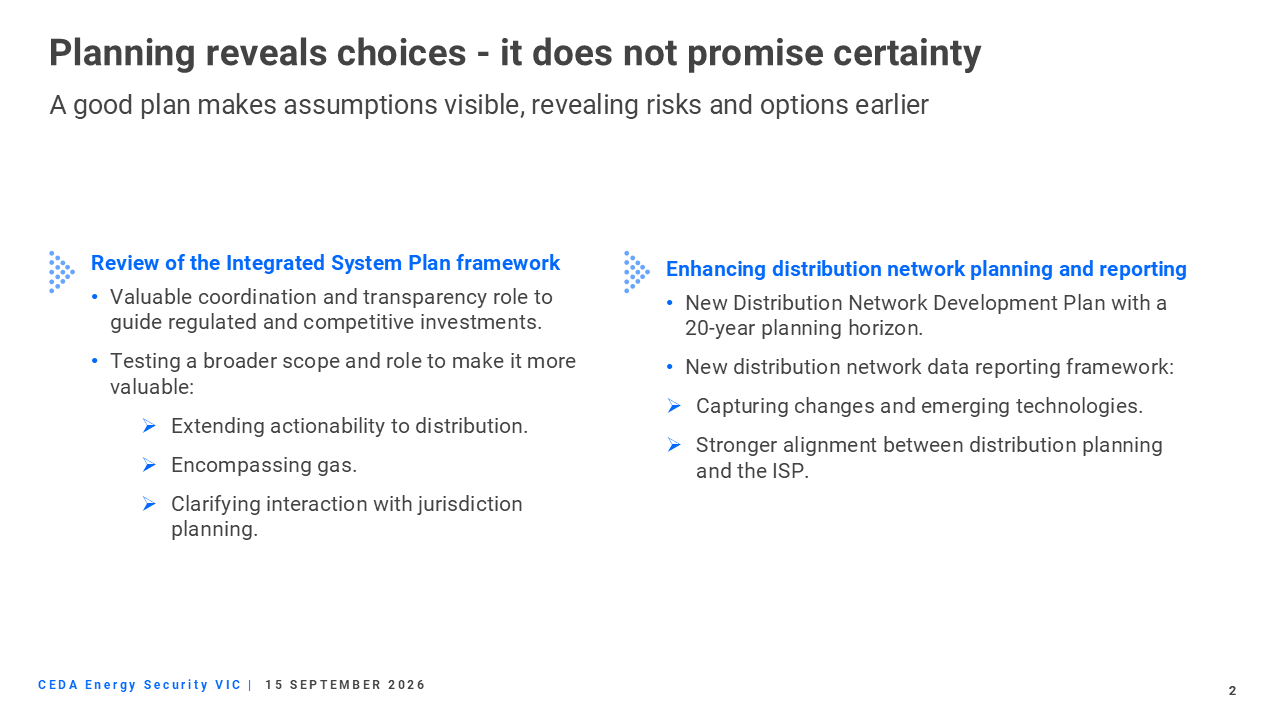
That is why long-term and transparent plans are so important.
They make assumptions visible. They show us the choices and trade-offs we face. And they give us the ability to change direction as the information and conditions change – which they will continue to do.
Take electrification – which is a big focus here in Victoria.
Households leaving gas obviously don’t just disappear from the energy system – their energy use moves somewhere else, which may increase electricity demand, change the local peak, affect investment requirements for poles and wires and alter the costs facing consumers who remain on the gas network.
Rooftop solar can reduce demand from the grid in the middle of the day, while increasing the importance of storage, flexible consumption and managing very low operational demand.
The planning frameworks must be able to see all of those interactions. This is a big focus of the AEMC’s review of AEMO’s ISP – which is currently underway.
The ISP remains valuable for guiding regulated and competitive investments.
We are asking what will make it more valuable, for example, extending actionability into the distribution network, encompassing gas infrastructure, and clarifying interactions with jurisdictional planning.
A fit-for-purpose model should be able to reveal whether investment in one part of the system can reduce, defer or avoid investment somewhere else.
We are applying the same philosophy closer to consumers.
The AEMC recently introduced reforms to electricity distribution planning that will require networks to publish a new development plan – with a 20-year outlook. This is to provide a more transparent and longer-term view of the low voltage network, as its role is transformed by EVs, household solar and batteries. This also has implications for transmission and large scale renewables.
Those outlooks will never produce a perfect forecast. The point is to reveal the choices early enough when we still have options.
Which brings me to reliability.
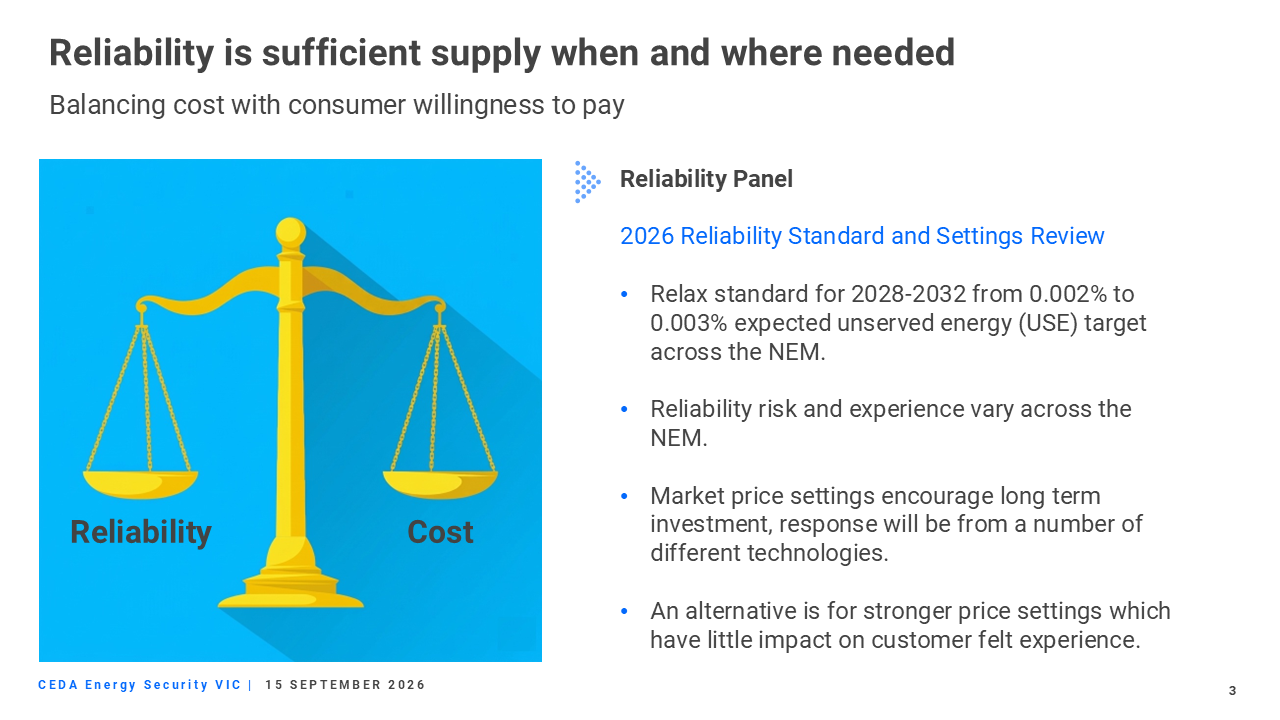
Reliability means having enough electricity available when and where consumers need it.
The job of the Reliability Panel is to help find the balance between the electricity reliability Australians value, and the cost of the investment required to provide it.
We could pay for more and more backup capacity to cover increasingly unlikely events. But the closer we get to eliminating that final bit of risk, the more expensive it becomes – because generation, storage and other capacity have to be available even if they’re rarely called on.
Earlier this year the Panel completed its four-yearly review of the Reliability Standard and Settings.
The NEM has historically delivered very high reliability with few interruptions due to a problem with supply. Around 99 per cent of consumer outages are caused by network issues rather than insufficient generation.
We are relaxing the standard from 0.002 per cent of expected unserved energy to 0.003 per cent from 2028. That is equivalent to moving from a long-term average of about 10 minutes to about 16 minutes of generation-driven outages per customer each year. It does not mean every customer will experience a 16-minute blackout each year.
That is a target across the NEM, but the nature of reliability risk differs between regions. Shortfalls can vary in how often they occur, how long they last and how large they are.
Our recommendation was based on extensive modelling and consultation that found that the cost of system reliability has increased, and the value customers place on reliability has fallen.
Maintaining the existing standard would require stronger price signals to encourage additional investment – beyond that which customers are willing to pay – for a relatively small additional improvement in reliability that will have little impact on what most customers will actually experience.
That recommendation is now before the AEMC to consider through its rule making process.
Gas powered generation continues to perform important reliability functions and we must maintain incentives for it to show up.
As we know, gas also presents future reliability questions of its own in Victoria.
Earlier this year the AEMC finalised reforms to strengthen the reliability and supply adequacy arrangements across the east coast gas system. They provide better information about emerging supply risks and clearer signals for the market to respond, before intervention is required.
We took a deliberate approach to rely on the market first – with better information and clearer signals – while making sure mechanisms are available if the market cannot resolve a serious supply shortfall on its own.
It is important to talk about the future role of gas.
Household gas use, gas distribution costs, industrial gas demand and gas fired generation in the electricity system are related issues. But they are not the same problem and will not necessarily change at the same pace. Longer-term plans can help identify and resolve those differences.
And that leads to perhaps the more difficult question – when the system changes, who carries the risk and who pays?
Gas distribution networks are a case in point. In parts of Australia, demand for gas is projected to decline, but many households and businesses will continue to rely on those networks for years.
Some will choose to switch – while others, including renters, apartment dwellers, and some industrial users – may face financial or technical barriers to switching.
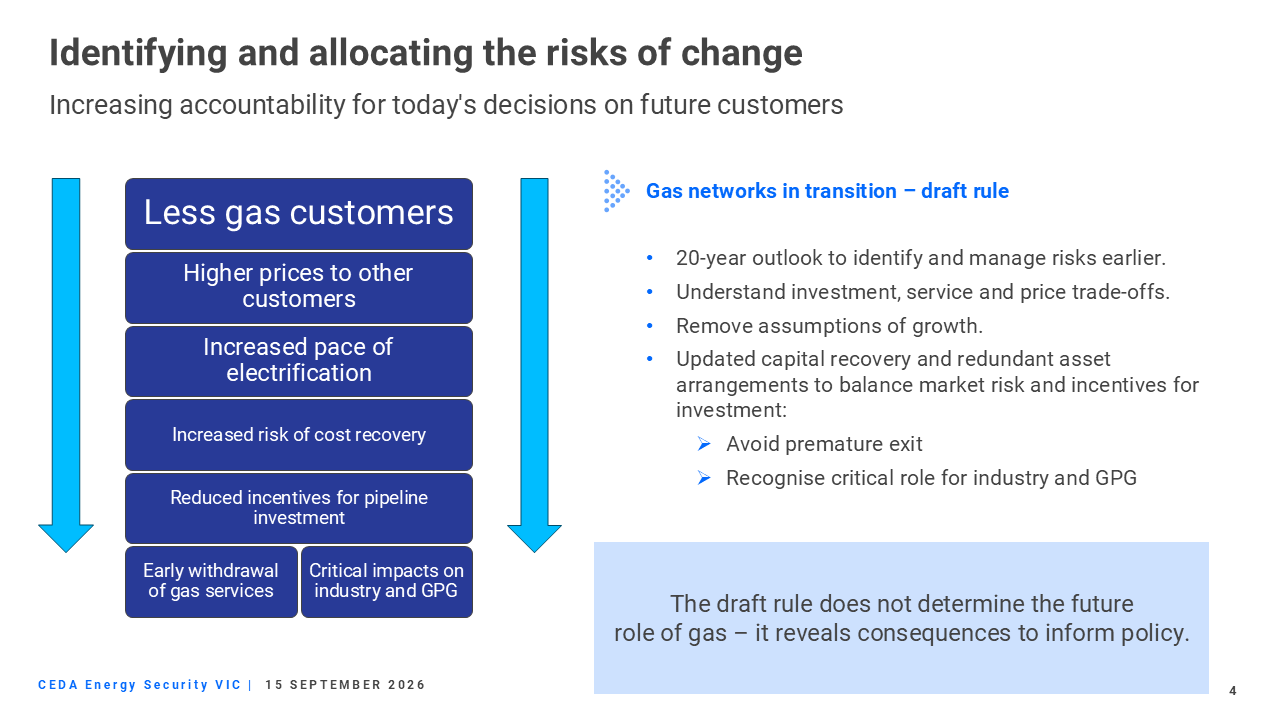
So if demand declines, the fixed costs of the networks are spread across fewer customers, which can put more pressure on the bills of those who remain.
At the same time, networks face greater uncertainty about recovering efficient investment in long-lived assets given the pace of electrification. If we don’t manage these risks well, it can weaken the incentives to maintain and invest in the safe and reliable services remaining customers still need.
There is no cost-free answer to that problem. The AEMC is currently consulting on a package of reforms intended to bring those risks into the open earlier.
Our draft rule would require gas networks – like electricity networks – to prepare a 20-year outlook. Investment would face stronger scrutiny. And regulatory tools for capital recovery, tariffs and redundant assets would be updated for a world where demand may decline, rather than grow. Investors will remain exposed to changing demand and market risk.
Some of these choices involve difficult trade-offs between consumers today and those into the future and we want to make those trade-offs transparent. But leaving too much to the future could result in a much smaller group of customers carrying much greater costs.
This principle is particularly important for Victoria.
The purpose of our draft rule is not to determine the future role of gas or to favour a particular transition pathway. Different governments – and political parties– will make different policy choices about that.
The national regulatory framework must promote efficient outcomes for consumers regardless of how the transition unfolds.
There are also limits to what economic regulation can do. Our job is to make sure the choices governments make about support for vulnerable consumers, decommissioning or the desired role of gas - are informed by transparent information about their consequences – and that the rules don’t make the problem worse.

We can no longer consider the gas and electricity systems as separate. Electrification, consumer energy resources, electric vehicles and storage will reshape the future of gas distribution networks, and place new demands on electricity networks.
Today, the lowest cost solution may sit across traditional boundaries between energy delivery and supply and gas and electricity.
The focus should be on which option delivers the service consumers need at the lowest long term cost. And this is even more relevant as consumer energy resources become a much larger part of the system. One day last October those resources met over 60 percent of demand across the NEM.
Victorian consumers have installed nearly 100-thousand small-scale batteries in just over a year. These can absorb power when it’s abundant, respond when the system is under pressure and potentially defer investment elsewhere. But that’s only if we have the right information and incentives.
Victoria has led the way in respect of better information by moving early on smart meters.
There were lessons from the rollout, but Victoria also showed the value of giving the system much greater visibility of when and where electricity is being used.
The national market is now following Victoria's lead, with universal smart meters expected by 2030 and new rights to access real-time electricity data from late 2028.
That information can help consumers make better decisions. This underpins the direction of the AEMC’s Pricing Review.
We have proposed a framework that allows consumers who want to actively participate to do so, while allowing others to have complexity managed for them – and rewarding choices that lower costs across the system.
That is what whole-system thinking means. Asking whether the overall outcome lowers costs for all consumers over time.
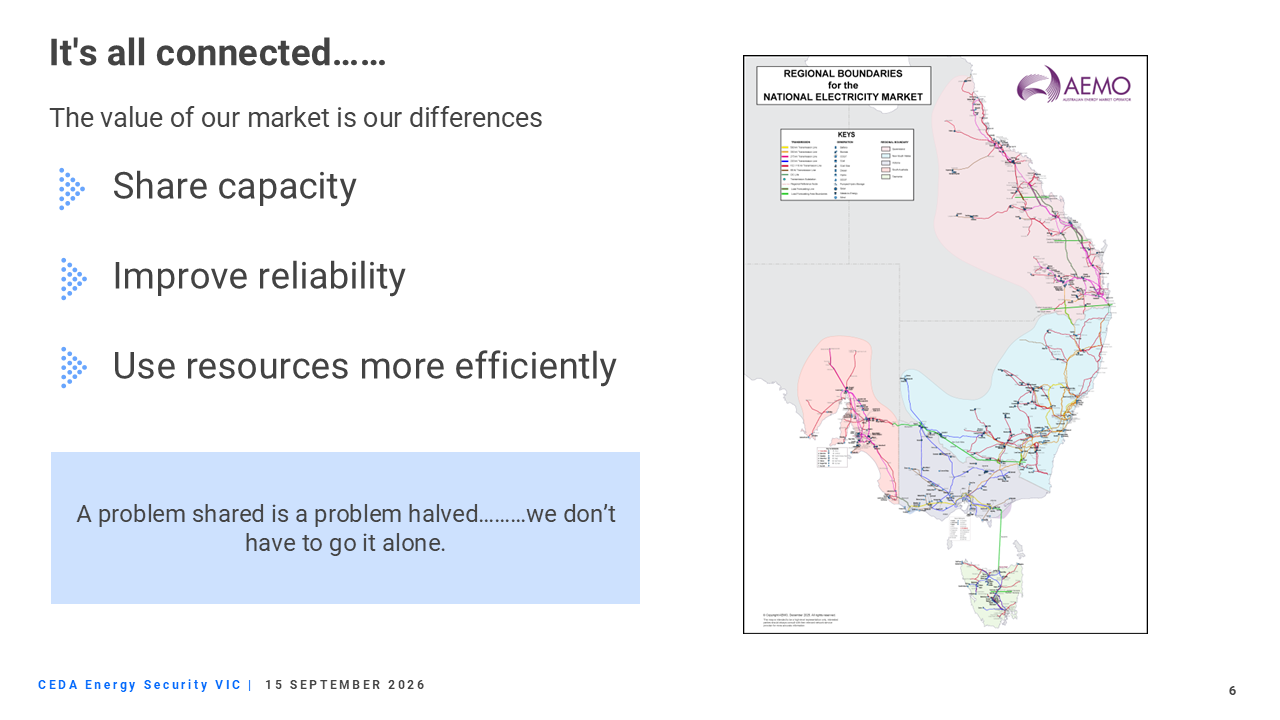
It all brings me back to a point I made earlier – the importance of a national electricity market. So let me finish on that.
Different states have always had different resources, demand profiles and priorities. Victoria and Queensland for example, are worlds apart.
The reason a national market was formed – nearly 30 years ago now – was never to eliminate those differences. It was to harness the value in those differences and use collective resources more efficiently. To trade across borders, share capacity, improve reliability and avoid every jurisdiction having to solve every problem alone.
Jurisdictions will continue to innovate and will sometimes choose different pathways. The national framework should learn from those choices and how to better leverage those differences to grow value.
So our challenge is to make the national framework work better for states as the transition evolves, preserve the benefits of coordination and avoid decisions in one part of the system unnecessarily imposing costs on another.
None of us can know precisely what the energy system will look like in 20 years. But we can make our assumptions visible, identify risks earlier and preserve choices while they are still available.
And we can keep our focus on a secure, reliable and affordable future energy system that serves customers over the long-term.
Thank-you.