Andrew Lewis, Executive General Manager, Consumer, Markets & Analytics
Keynote address, AI for Energy Transition APAC 2026
Melbourne Convention and Exhibition Centre
Good morning.
Before I begin, I’d like to acknowledge the Traditional Owners of the land on which we meet today, the Wurundjeri Woi Wurrung people of the Kulin Nation. I pay my respects to their Elders past and present.
Thank you for that introduction and the opportunity to speak here today.
This is an important summit.
In many ways AI is reshaping the energy system.
The challenge before us is how to enable it to genuinely serve the interests of energy consumers.
To give them more control.
Better choices.
And, of course, help lower their energy wallet expenses.
The AEMC’s role is not to choose which specific AI innovations or applications are best placed to do this.
There are many others here working on that front.
We want to get the settings right to allow those opportunities to emerge.
And there are three areas in particular that we are focused on:
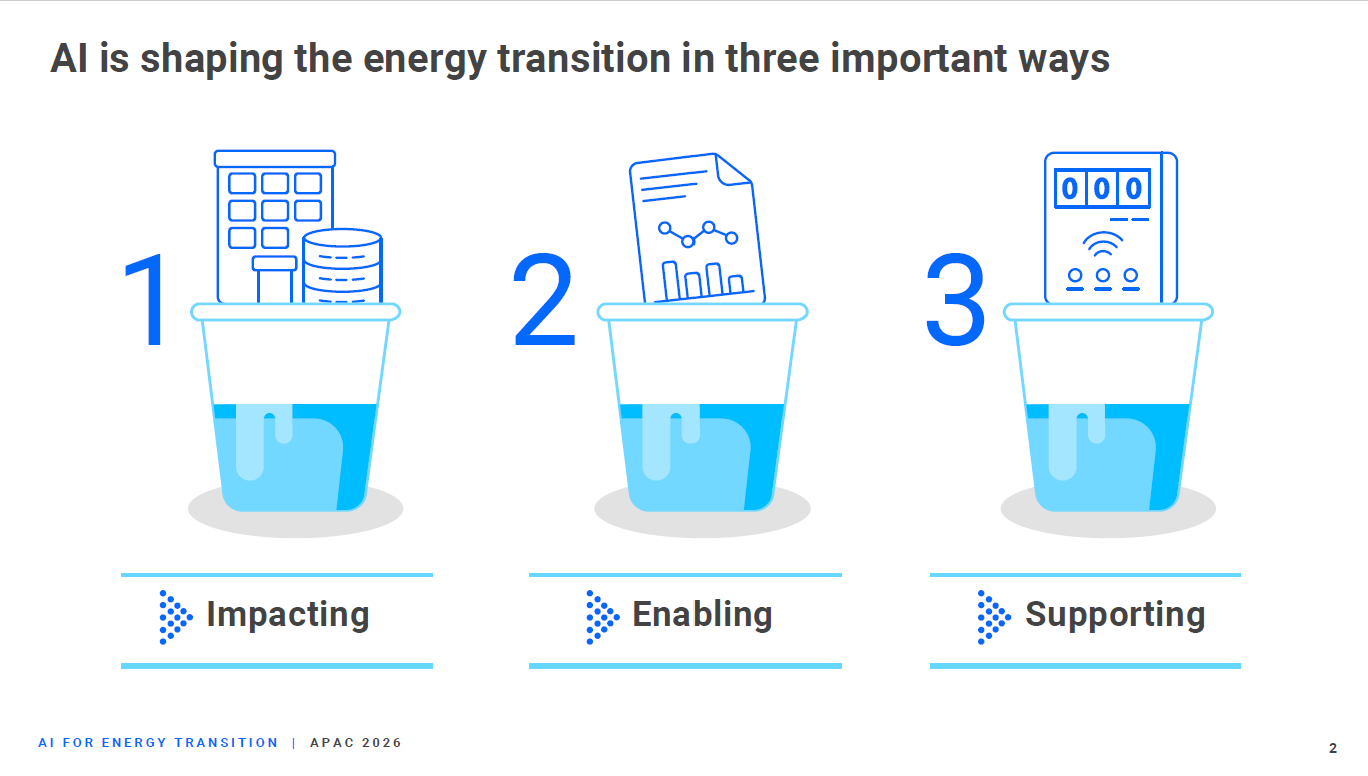
First, is AI’s potential direct impact on the energy system, such as through data centres – the load they consume and the services they can provide.
Second, is improving the visibility, quality and security of energy data.
Because AI is only as powerful, useful and beneficial as the data it is able to access.
And third, is how the AEMC uses AI internally to support an increasing workload and the greater complexity that comes with being at the centre of an energy transition of this scale.
So let me first go to data centres, because there are two pieces of work we are doing that are understandably attracting a lot of interest.
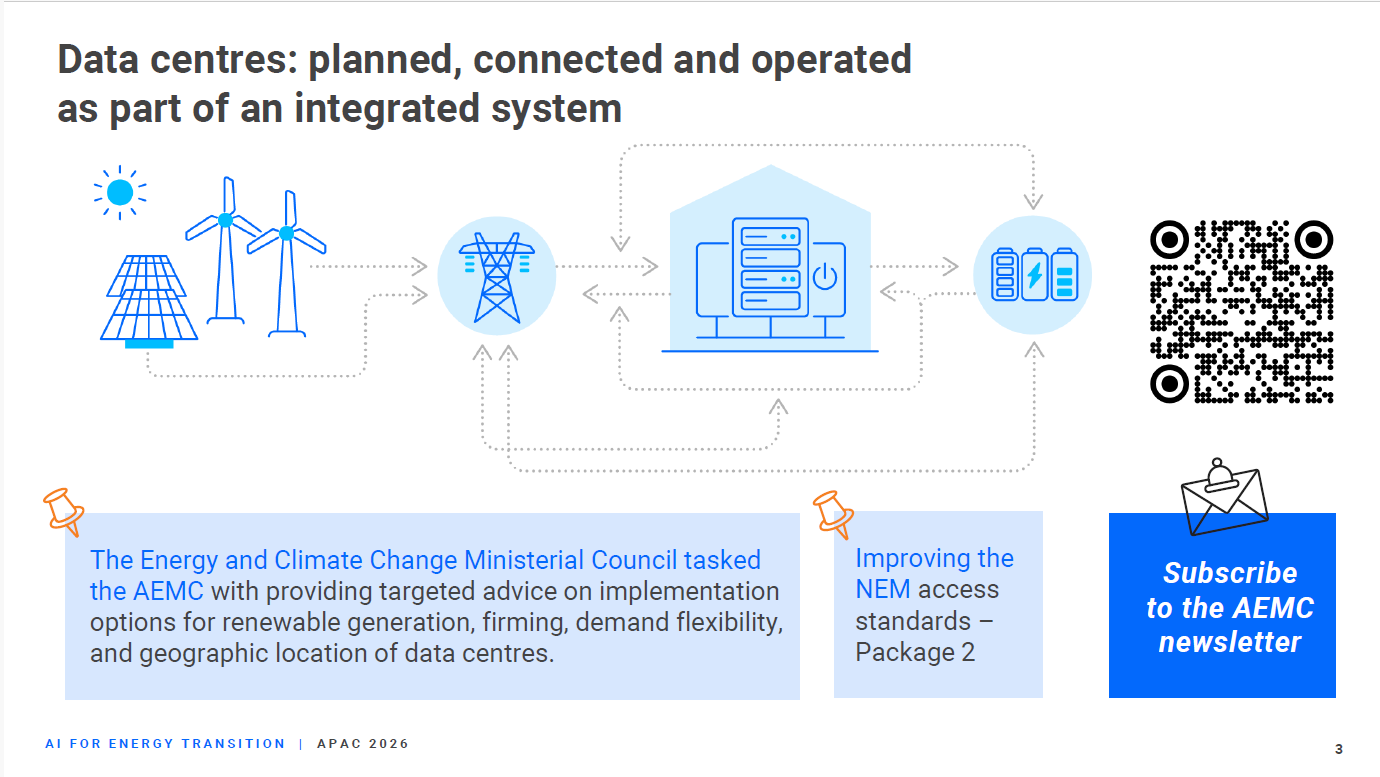
As many of you will be aware, Energy Ministers recently asked us for advice on how to ensure data centres fully offset their demand with renewable generation, firming and demand flexibility.
We’ll deliver the final advice later this month.
To be clear - Ministers have already set their direction on this.
Our advice is solely on how it could be implemented – not whether they should proceed.
We’re also updating technical standards for connecting very large loads – including data centres – to the grid.
And we are expecting to receive at least two more rule change requests.
One that seeks to address phantom data centre demand.
And another from AEMO on improving the operational integration and visibility of large loads.
We obviously recognise that data centres are not all the same.
Nor are they the problem in themselves.
They are the latest load challenge – comparable to how air conditioning changed demand patterns two decades, but faster, larger and more concentrated.
The AEMC’s role is to enhance the frameworks to ensure they are planned, connected and operated as part of an integrated energy system.
So, in all cases, the goal is to get ahead of the projected growth of data centre load, and help make sure energy consumers are not left worse off.
As we’ve seen abroad, regulating reactively – or unwinding poorly designed regulations - can be far more costly for everyone.
We’re obviously taking this work very seriously and will have more to say.
There is a QR code on the slide for anyone who’d like to follow these projects and others.
Energy data has also become fundamental to whether the transition succeeds or fails, particularly for consumers.
AI has the potential to be a game-changing, enabling force in this space.
This is especially the case for Australia’s distinctive transition.
We are not simply replacing coal and gas with different forms of large-scale synchronous dispatchable generation.
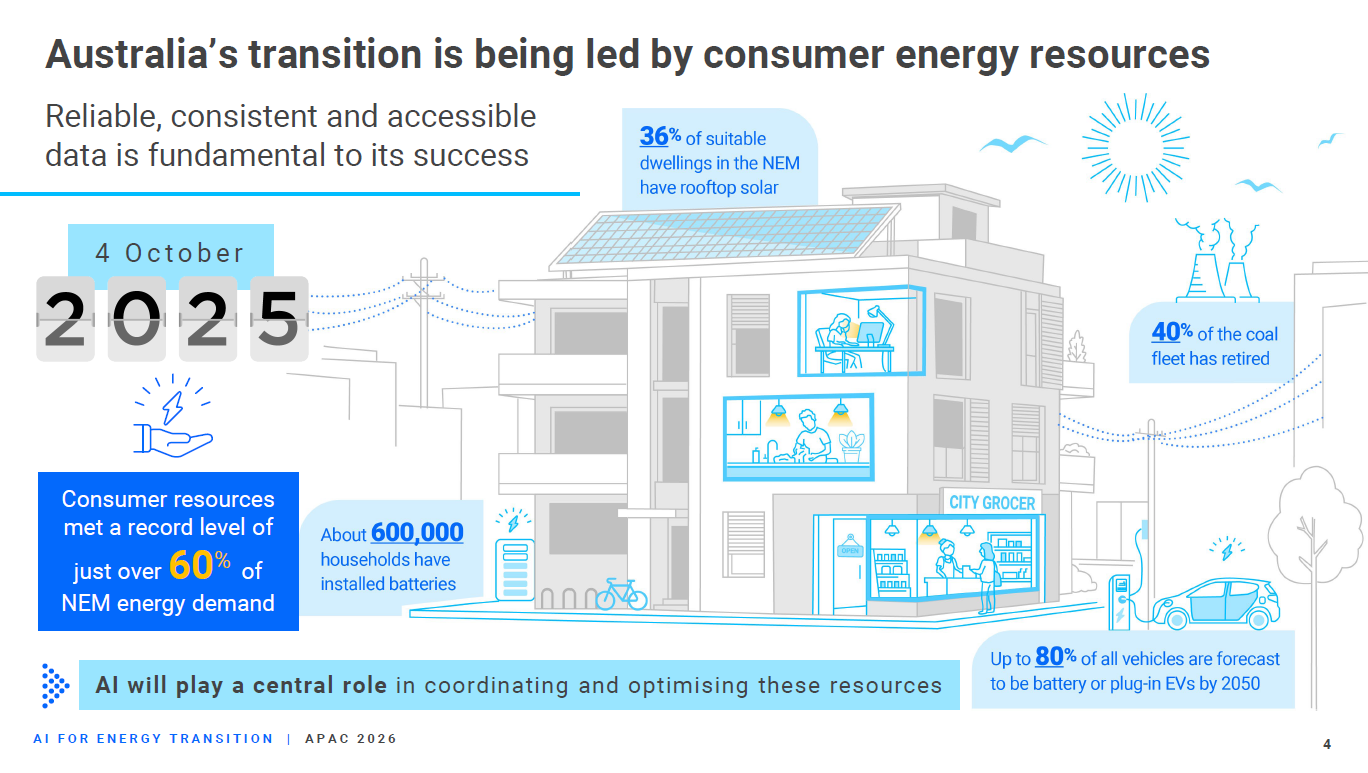
Our power system is increasingly being shaped by rooftop solar, home batteries, EVs and energy management systems - all sitting behind the meter.
In fact, last October small-scale consumer resources met over 60 per cent of demand across the National Electricity Market.
This trend will only grow.
You just need to look at the 450,000 home batteries that have been installed, just in the last 12 months.
This is a good news story for millions of consumers.
It gives them more control.
Helps lower their bills.
And, if the way those resources are being used is well understood, can reduce costs across the whole system.
But that last point is critical – if their use is well understood.
Because the old energy system was built around visibility and control.
AEMO had clear visibility over large scale generators.
Networks were one-way highways, carrying electricity from large power stations to passive households and businesses.
That system no longer exists.
Power now flows both ways.
And the biggest generator is dispersed across millions of smaller devices, that are virtually invisible and therefore harder to forecast, understand, and for those who are willing, coordinate.
That creates new pressures on the grid, and - without better visibility and orchestration - could drive costly upgrades that ultimately land on consumer bills.
The AEMC has introduced several reforms to get ahead of these challenges.
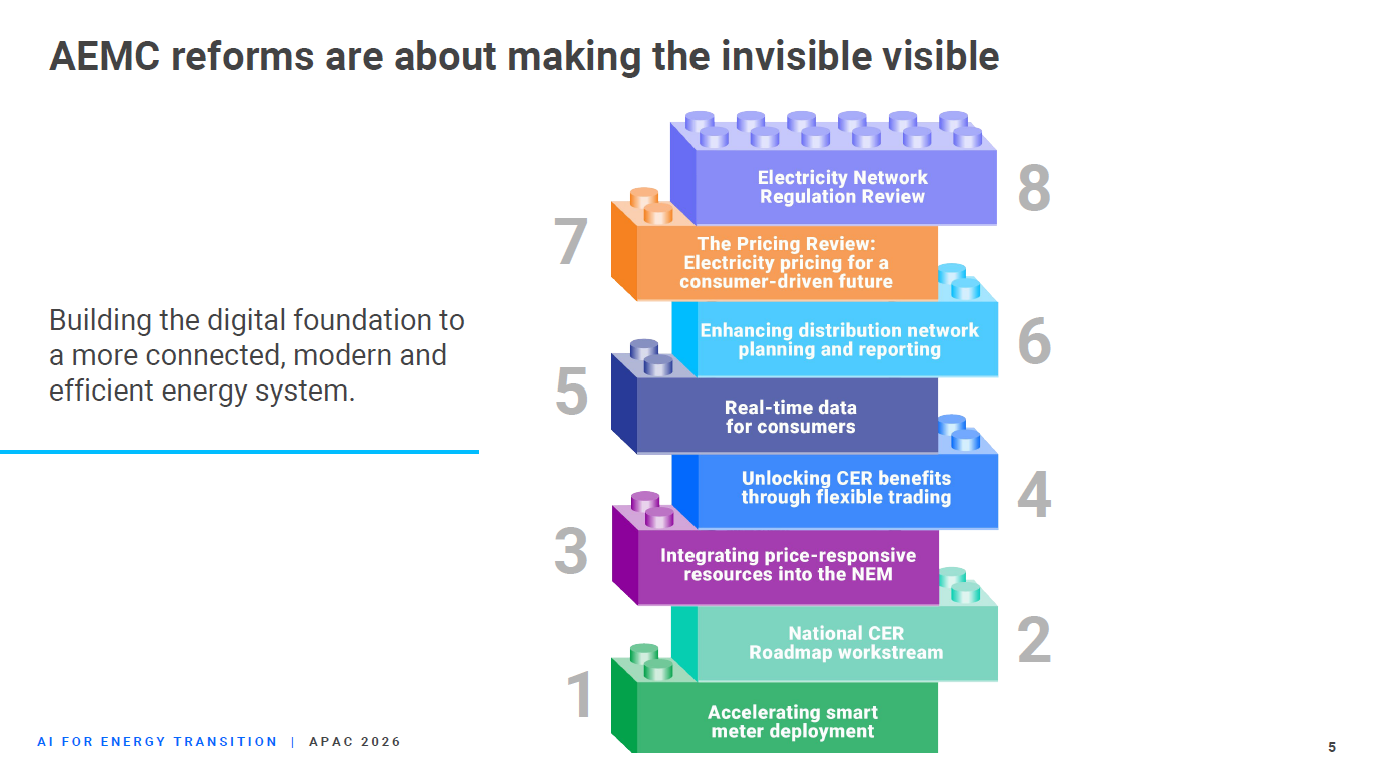
The most significant is our 2024 rule that requires universal smart meter deployment across the National Energy Market by 2030.
The data from smart meters is the foundational building block of a more connected, modern and efficient energy system.
And a lot of our work since that reform is about securely building on this foundation.
We have made a new rule to give consumers the right to access their real-time data from smart meters, free of charge.
We’ve changed the rules so aggregated consumer energy resources – such as virtual power plants or community batteries – can participate in the wholesale market and compete with traditional power stations.
These reforms - and others - are about making the invisible, visible.
But the data is only useful if the system can act on it.
And that is where AI has such enormous potential.
It can help retailers better understand how customers use energy, and tailor products and services to their individual needs.
At the network level – which accounts for up to half a typical household power bill – advanced data algorithms can help identify constraints, forecast local demand, manage two-way flows and make better use of existing infrastructure, before building more expensive poles and wires.
A simple way to think about it is Google Maps.
Google Maps works because millions of data points are securely aggregated and turned into useful guidance.
It sees traffic building before you reach it and suggests a better route.
And each driver’s decision helps the whole road network work more efficiently.
This is the kind of shift we need in energy.
A system where data, digital tools and clear, proactive rules help millions of individual resources work together.
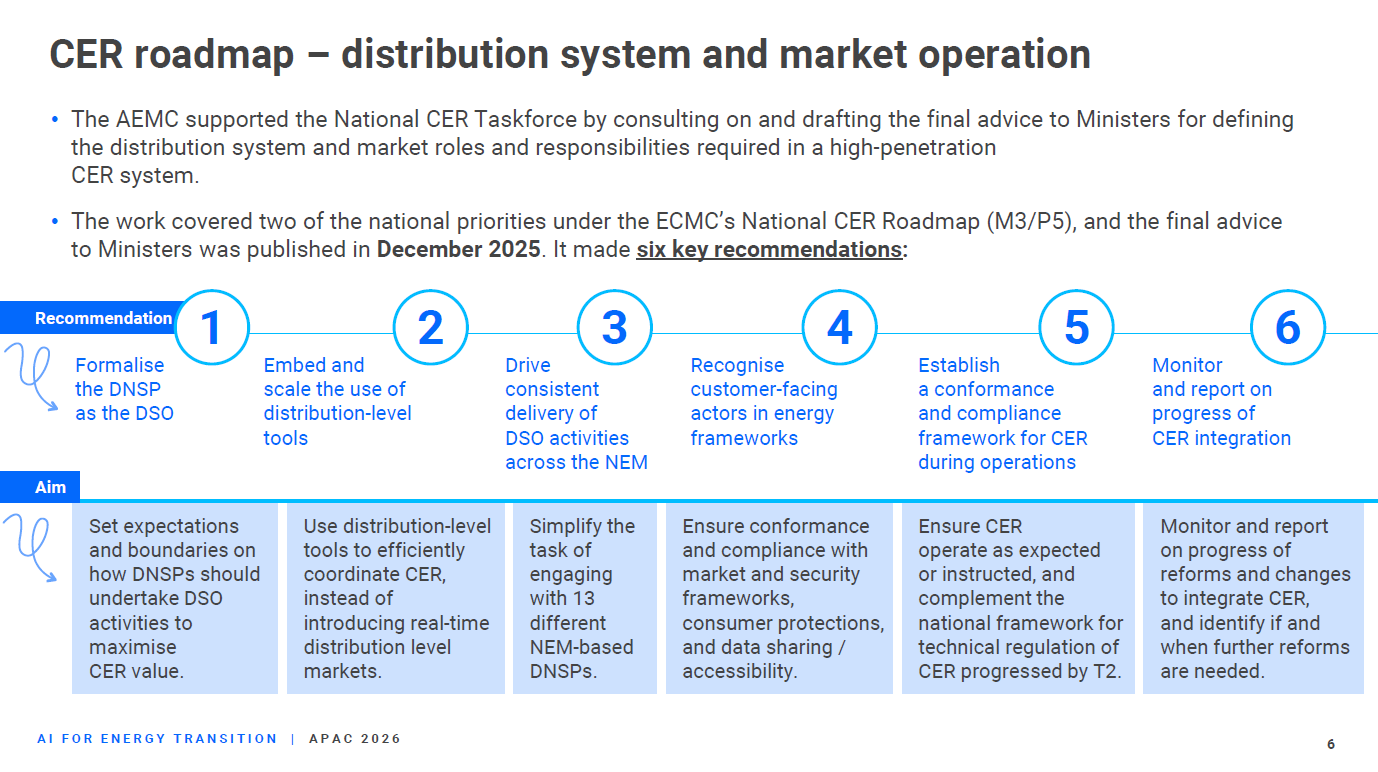
The AEMC undertook work that resulted in formalising distribution network businesses as the Distribution System Operator – or DSO.
In simple terms, this will assign the DSO with key responsibilities and strong incentives to maximise the use of consumer energy resources, for a whole of system benefit.
And AI will become increasingly important in supporting the DSO by analysing the data in real time, and helping the system respond to it.
That could mean making better use of solar exports, coordinating household batteries, managing EV charging or forecasting when demand is about to rise.
So, there is a lot of low-hanging fruit here that those working on AI products and services can harvest.
The AEMC’s Pricing Review – and our current Electricity Network Regulation Review – also speak to the future potential of these technologies in realising our goal of a consumer-focused net zero energy system.
Another data-set ripe for the picking relates to weather.
In a thermal system, reliability risk was often dominated by large unit outages and peak demand.
In the new renewable-dominated system we are building, it’s increasingly weather-driven.
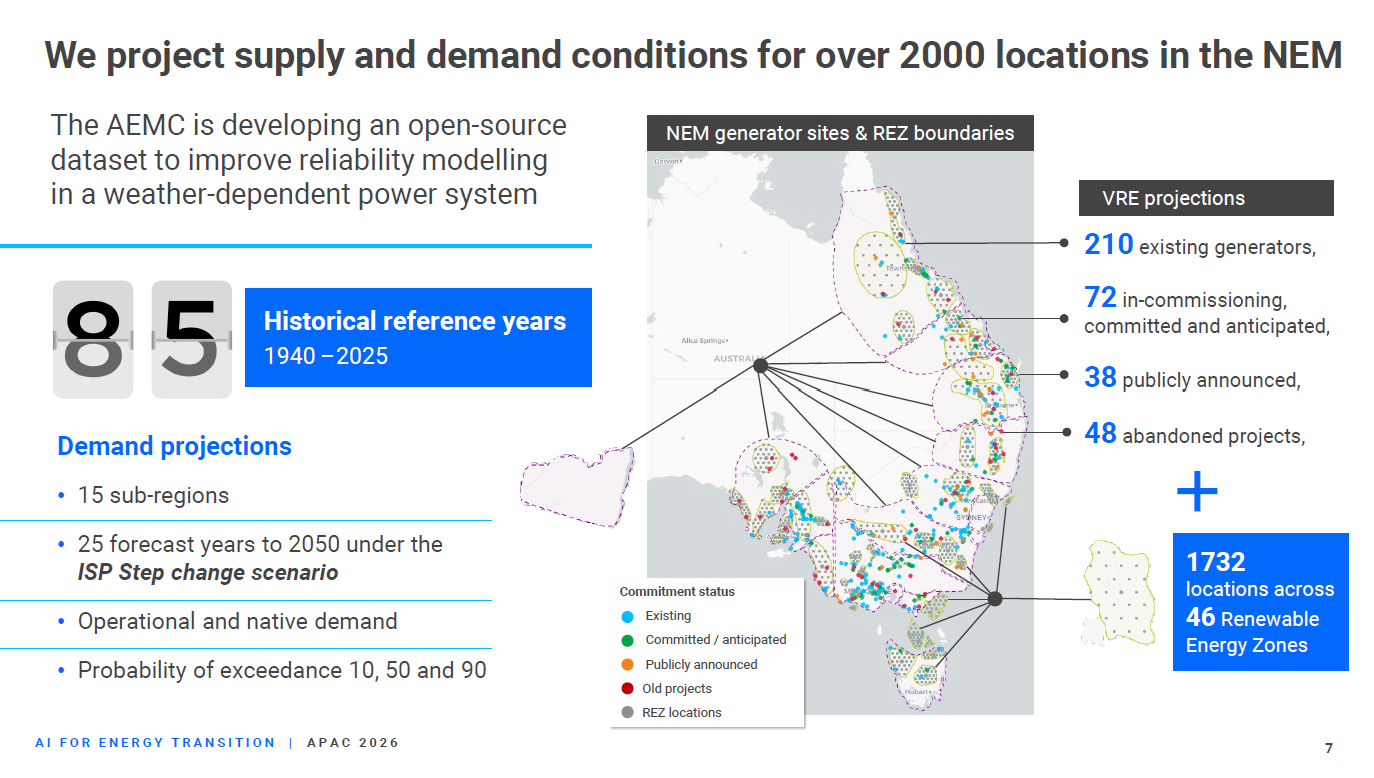
The AEMC is developing in-house modelling with an 85-year set of weather reference years for both supply and demand.
It uses historical re-analysis of weather data to generate normalised wind and solar output for more than 2-thousand locations across the NEM - from 1940 to the present.
We plan to publish it open source, to bring a much deeper understanding of weather-driven risk.
But it’s true potential grows alongside the development of data-driven algorithms.
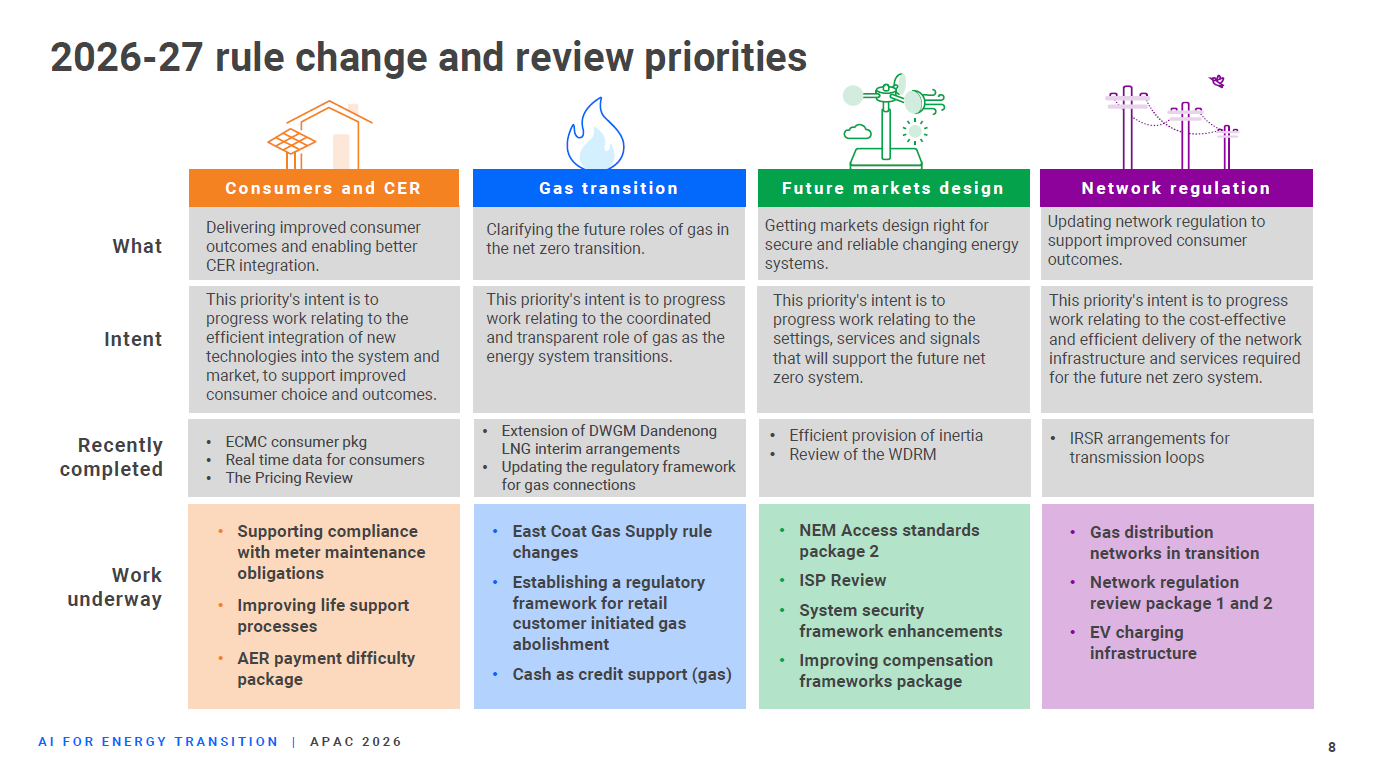
As you may have gathered by now, the AEMC has many irons in the fire.
We are being asked to do more – through rule changes, reviews and advice to governments.
It’s exciting for energy-nerds like us to be working at the frontier of a system being rebuilt from the ground up.
But with it comes many new and difficult questions.
Stalling, or getting them wrong, has big consequences.
Another barrier is that we are a small organisation.
Like everyone in energy right now, we face recruitment challenges.
And in these economic times, there is only so much taxpayer funding we can ask for to grow further.
So we’ve had to have a laser like focus on ourselves to become more efficient and targeted in what we do.
Here is AI’s supporting role in the transition.
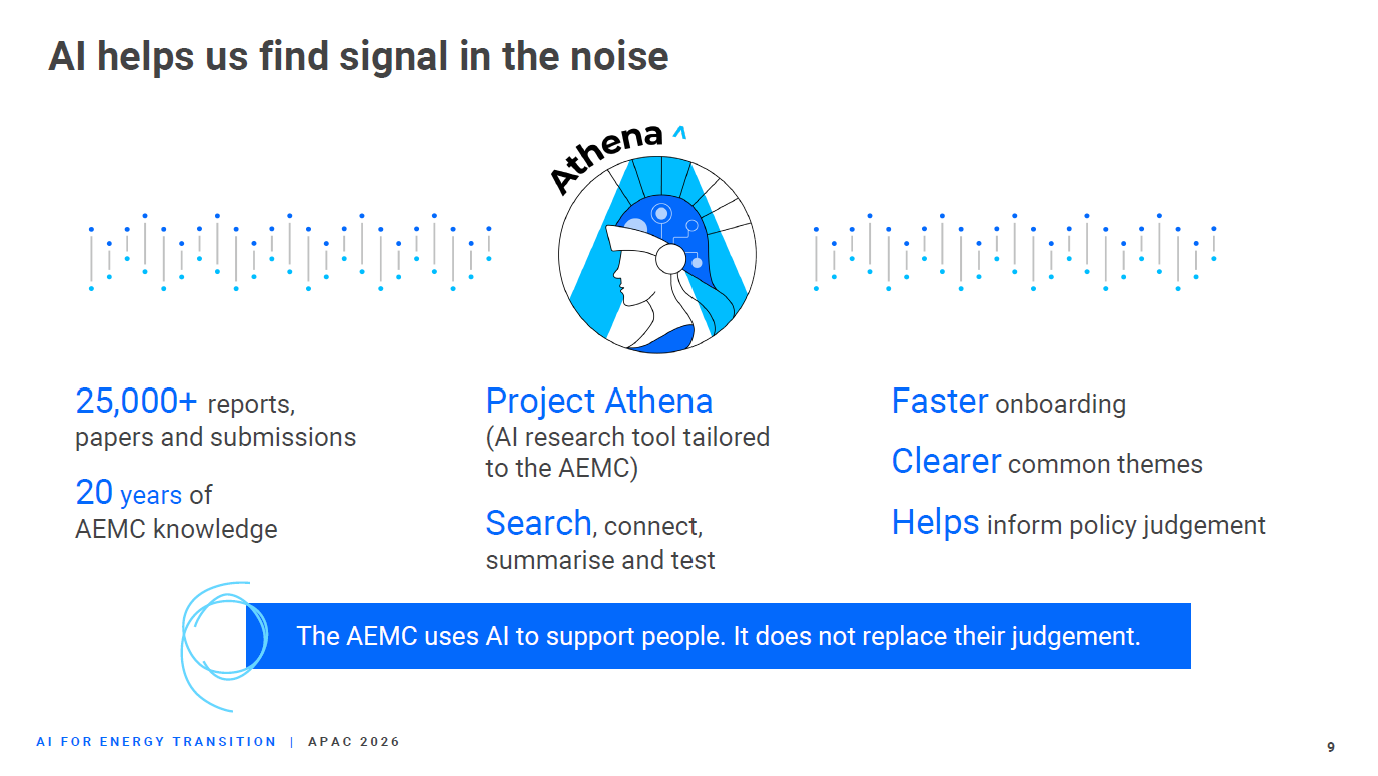
We’ve developed our own specialised tools to improve our processing and analytical capability.
To interrogate our database of over 25,000 reports, consultation papers and submissions, going back two decades.
To support new employees who don’t have that depth of knowledge.
To find the common threads quickly and turn them into insights that support better decisions.
And to test those insights against a complex web of energy rules, laws and objectives that are never static and must be weighed in every decision we make.
It’s obviously not about replacing people.
Rather, AI can free small teams up to focus on policy judgement and solutions to the many complex questions – including about data centres and optimising consumer energy resources.
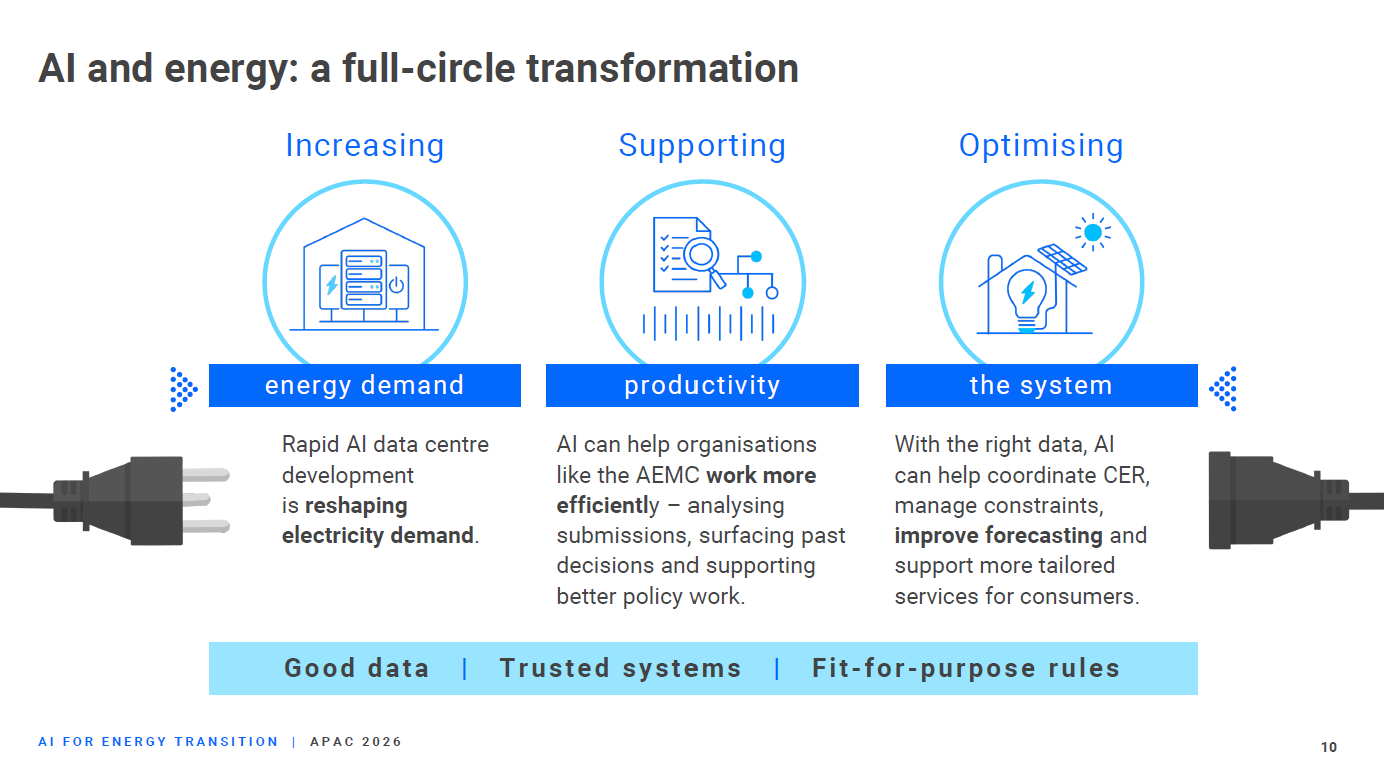
The point I’m trying to make is that AI’s influence on energy is full circle.
It’s already impacting, supporting and enabling the transition – all at once.
With that comes obvious risk – particularly around data security.
While AI offers lots of benefits and opportunities, we need to do more to understand those benefits as well as the potential risks, such as from potential algorithmic collusion.
These require ongoing attention and investigation – and the AEMC is very alive to this.
But the opportunities, if regulation keeps pace, are immeasurable.
Used well, energy data can connect the system in new and extraordinary ways.
To channel millions of individual decisions into better outcomes for the system as a whole.
So my message today is one of tempered optimism.
We need to be on the front foot in aligning the AI transformation with the energy transition, so everyone can share in the benefits.
The AEMC will continue to take a technology neutral and pragmatic approach to updating the regulatory settings.
We will not make new rules for their own sake.
But we are also alert to the costs to consumers, investors and the system if policy and regulation fall behind.
Therefore, we want to keep broadening the conversation.
And I encourage those working in AI, data centres and energy technology to engage with us, challenge us, and help us understand where the next opportunities and risks are emerging.
Thank you.