Rule Change: Open
Overview
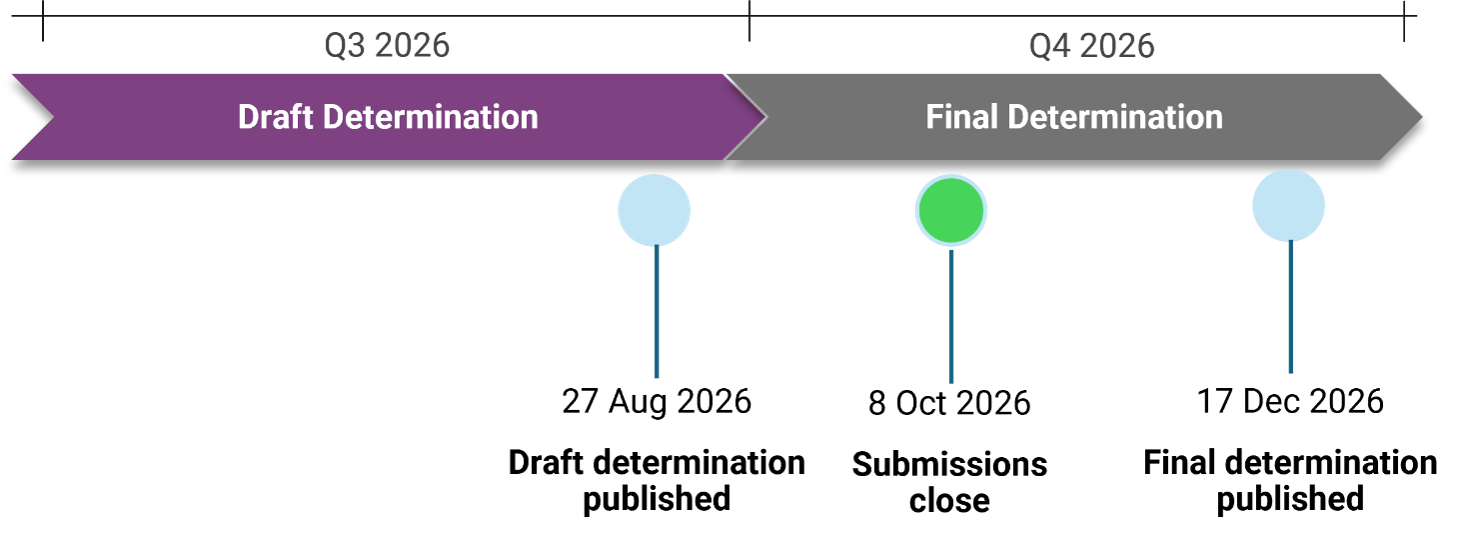
On 27 August 2026, the Australian Energy Market Commission published its draft determination and draft rule for the Gas networks in transition rule change project.
The draft rule would update the gas pipeline economic regulatory framework to support efficient decision-making in a changing energy system while continuing to promote the long-term interests of gas consumers.
We have made a more preferable draft rule to ensure the gas regulatory framework remains fit for purpose
Our more preferable draft rule contains a package of reforms that work together to support an orderly energy transition, including:
- Improving transparency and accountability in decision-making under uncertainty by employing a longer-term outlook. The draft rule would introduce new requirements on service providers to prepare and publish a 20-year outlook to support access arrangement proposals. Service providers and regulators would also be required to consider the long-term outlook and explain the consequences of proposals and decisions over the longer term. This would support forward-looking, consumer-centric and informed decision-making by ensuring long-term risks and consequences are transparently considered and communicated in access arrangement processes.
- Supporting efficient capital recovery that promotes the long-term interests of consumers. The draft rule would amend the depreciation, compensation for inflation, redundant capital and return of redundant capital provisions to better align capital cost recovery with the expected use of a pipeline over time and better reflect the competitive pressures that arise in a workably competitive market. The draft rule would promote efficient tariff outcomes for consumers while preserving the incentives on service providers to continue to provide safe and reliable services, for as long as consumers continue to rely on gas to help meet their energy needs.
- Strengthening transparency and accountability for expenditure decisions. The draft rule would amend the expenditure assessment framework to strengthen the quality of expenditure assessment in an environment of uncertain and potentially declining demand. The draft rule is intended to minimise costs to consumers by requiring greater justification and scrutiny of new expenditure to ensure new expenditure is strictly necessary to provide safe and reliable services.
- Supporting a broader range of incentive mechanisms. The draft rule would amend the incentive mechanism framework to allow for mechanisms that contribute more broadly to the achievement of the National Gas Objective. This would provide additional flexibility to accommodate future circumstances where new or modified incentives may be required to encourage efficient operation of ageing assets or other behaviours that promote consumers’ long-term interests.
- Guiding the design of efficient tariff arrangements for different transition scenarios. The draft rule would amend distribution pipeline reference tariff arrangements to better support efficient outcomes across a broader range of transition scenarios, including by recognising competition from alternative energy sources and focusing tariff design on the efficient use of networks. The draft rule would also require gas transmission and distribution pipeline service providers to consider and explain the impacts of reference tariff arrangements and tariff variation mechanisms on consumers over the access arrangement period.
- Updating access arrangement revision timeframes. The draft rule would extend access arrangement timeframes to allow service providers and the regulator additional time given the new and changed requirements.
The draft rule also includes transitional arrangements to support a smooth and orderly implementation of reforms through a staged process.
The draft rule would apply to scheme transmission and distribution pipelines regulated under the NGR, as adopted in each jurisdiction.
We are interested in your feedback on the draft determination and draft rule. Submissions close on 8 October 2026.
We will be hosting an online public forum on Tuesday 22 September 2026, from 11:30 am-12:30 pm (AEST). The forum will provide a brief overview of the draft determination and allow more time for stakeholders to ask us questions. Register here.
Project timeline
Background
The Commission initiated the Gas networks in transition rule change process in response to four rule change requests submitted by Energy Consumers Australia (ECA) and the Justice and Equity Centre (JEC). ECA submitted its rule change requests on 14 February 2025, and JEC submitted its rule change request on 4 June 2025. The rule change requests relate to the following aspects of the economic regulatory framework for gas pipelines:
- Depreciation. ECA propose stronger conditions on when gas distribution service providers and the regulator can accelerate the recovery of capital costs through changes to the depreciation criteria.
- Capital and operating expenditure. ECA propose changes to the capital expenditure (capex) provisions and operating expenditure (opex) definition to ensure that only efficient expenditure is incurred and paid for by gas consumers in the context of declining demand.
- Planning requirements. ECA propose new planning reporting obligations on gas distribution service providers to provide regulators, governments, electricity networks, and other stakeholders with information required to understand the opportunities to minimise expenditure and energy system costs.
- Accelerated depreciation and redundancy. JEC propose changes to the depreciation and redundant asset provisions. Their proposed changes would prohibit the use of accelerated depreciation to manage stranding risks in combination with the use of the capital redundancy provisions. JEC further propose to cap the customer contribution to 50 per cent, in the case of a cost sharing arrangement.
On 18 September 2025, the Commission published a consultation paper jointly consulting and seeking stakeholder feedback on the issues raised by the two rule change proponents. We received 26 responses to our consultation paper.
On 18 December 2025, the Commission consolidated the ECA and JEC rule change requests. We decided that the breadth and interrelated nature of the issues considered in our consultation paper and raised by stakeholders requires a holistic approach when considering changes to the NGR.
On 19 March 2026, the Commission published a directions paper detailing its proposed direction for the Gas networks in transition project. We received 22 submissions to our directions paper.