APA Group

WA: Goldfields Gas Pipeline (GGP)

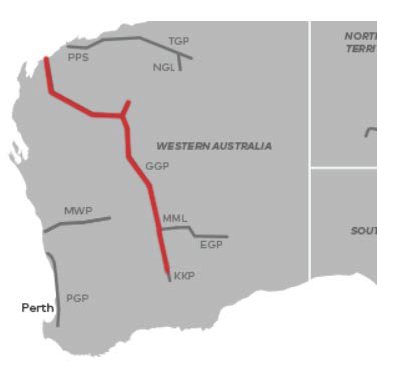
The Goldfields Gas Pipeline (GGP) is the gas transmission pipeline system defined in Pipeline Licence 24 (as amended) issued under the Western Australian Petroleum Pipelines Act 1969.
 
The GGP extends from Yarraloola, in the Pilbara region of Western Australia, to Kalgoorlie, in the Goldfields-Esperance region servicing the towns of Karratha, Paraburdoo, Newman, Wiluna, Leinster, Leonara and Kalgoorlie. The GGP is 1378 km, with a capacity of 202 TJ/day, and has nominal diameters of (Yaraloola to Newman offtake) DN400 and (Newman to Kalgoorlie) DN350.
 
The pipeline system defined in Pipeline Licence 24 includes the pipeline between the Quadrant Energy meter station near Yarraloola and the Yarraloola Compressor Station.  It also includes a part of the pipeline which interconnects the GGP with the Dampier to Bunbury Natural Gas Pipeline upstream of the Yarraloola Compressor Station. The Newman Lateral, which extends 47 km from the GGP main line to the town of Newman, is part of the pipeline system defined in Pipeline Licence 24.  None of the other lateral pipelines extending from the GGP main line is part of the pipeline system defined in Pipeline Licence 24.
 
The following lateral pipelines form part of the GGP pipeline:

Paraburdoo Lateral (not APA owned)
West Angelas Lateral (not APA owned)
Newman Lateral - 1995, 47km, DN200, 40 TJ/d
Beyondie Lateral (not APA owned) 
Savory Creek/Karlawinda Lateral - 2021, 56 km, DN100, 10 TJ/d
Plutonic Lateral (not APA owned)
Jundee Lateral (not APA owned)
Lake Way Lateral - 2021, 26km, DN100, 1.9 TJ/d
Wiluna Gold Lateral - 2001, 8km, DN80, 8 TJ/d
Mount Keith Lateral - 1996, 8km, DN200, 15 TJ/d
Cosmos Lateral (not APA owned)
Leinster Lateral - 1996, 5km, DN200, 78.5 TJ/day 
Agnew Lateral - 2019, 24.4km, DN150, 4.1 TJ/day
Thunderbox Lateral (not APA owned) 
Jaguar Lateral (not APA owned)
King of the Hills Lateral - 2022, 13km, DN100, 6 TJ.d
Parkeston Lateral - 1996, 8km, DN200, 5 TJ/d

 
Construction of the GGP was completed in 1996.  The GGP mainline comprises two principal segments:  520 km of 406 mm diameter pipe between Yarraloola and the Newman Lateral offtake, and 857 km of 356 mm diameter pipe between the Newman Lateral offtake and Kalgoorlie.  Compressor units were initially installed at Yarraloola (Units 1 and 2) and Ilgarari.  The gas transportation capacity was of the pipeline was subsequently expanded by the addition of compression at Wiluna in 2001, and at Paraburdoo (Unit 1) in 2004.  Compression was subsequently added at Yarraloola (Unit 3), Wyloo West, Paraburdoo (Units 2 and 3), Turee Creek, and Ned’s Creek.
 
The GGP is owned by the participants in the Goldfields Gas Transmission Joint Venture.  The participants are currently Southern Cross Pipelines Australia Pty Ltd, Southern Cross Pipelines (NPL) Australia Pty Ltd and APA GGT Pty Limited. These are all part of the APA group.
 
Construction of the GGP, and its subsequent operation, have been facilitated by an agreement between the Goldfields Gas Transmission Joint Venture participants and the State of Western Australia, which was ratified by the Goldfields Gas Pipeline Agreement Act 1994.
 
The Goldfields Gas Transmission Joint Venture participants assigned the tasks of developing and operating the GGP to a manager.  The manager is Goldfields Gas Transmission Pty Ltd.  Goldfields Gas Transmission Pty Ltd is now an entity within APA Group.
 
The GGP is a covered pipeline under the access regime of the National Gas Law and the National Gas Rules.  However, a part of the gas transportation capacity of the GGP is provided by assets which are uncovered, and that part of the capacity is not subject to the requirements of the access regime.  These uncovered GGP assets are:
 
  • Compressor Unit 3 at Yarraloola, which was installed in 2013;
  • the compressor station at Wyloo West, which was constructed in 2009;
  • Compressor Units 2 and 3 at the Paraburdoo Compressor Station, which were installed in 2007 and 2013, respectively;
  • the compressor station at Turee Creek, which was constructed in 2014; and
  • the compressor station at Ned’s Creek, which was constructed in 2009.


The following augmentations have been made since initial commissioning:

1996: Pipeline commissioned with Yarraloola Units 1 & 2 (reciprocating compressors) and Ilgarari Units 1 &2 (reciprocating compressors),  Nameplate: 70 TJ/d
2001: Wiluna compressor installation,  Nameplate: 76 TJ/d
2003: Paraburdoo Unit 1 Compressor (Saturn 20) installation,  Nameplate: 106 TJ/d
2006-2009: Paraburdoo Unit 2 (Centaur 40), Wyloo West & Neds Creek (Centaur 50) compressors installation, Nameplate: 155 TJ/d
2014: Yarraloola Unit 3 & Paraburdoo Unit 3 (Centaur 50) compressors installation, Nameplate: 178 TJ/d
2014:  Turee Creek Unit 1 & 2 (Centaur 50) compressors installation, Nameplate: 202 TJ/d
 

Pipeline details

State:

WA

Type:

Transmission

Capacity:

202 TJ/day

Regulation:

Scheme

Owner:

APA Group

Operator:

APA Group

Length:

1,378 km

Gas Type:

Natural gas

Contact us

Title Date Documents
ERA Approved Revised Access Arrangement 2020-2024 2020-01-01 Current access arrangement
ERA Approved Access Arrangement 2020-2024 2019-12-19 Current access arrangement
Goldfields Gas Pipeline 2025-29 Access Arrangement 2025-01-01 Current access arrangement
Access Arrangement Information for the Goldfields Gas Pipeline (2025 to 2029) 2025-01-01 Current access arrangement
Minister's decision on revocation of coverage 2004-07-02 Coverage decision
Final recommendation on application for revocation of coverage – NCC 2003-11-27 Coverage decision
Amended access arrangement by order of the WA Electricity Review Board 2012-04-13 Coverage decision
Amended access arrangement (appendix 2.1) by order of the WA Electricity Review Board 2012-04-13 Coverage decision
Amended access arrangement (appendix 3) by order of the WA Electricity Review Board 2012-04-13 Coverage decision
Amended access arrangement information by order of the WA Electricity Review Board 2012-04-13 Coverage decision
ERA approved access arrangement - GGT 2008-12-17 Previous access arrangements
ERA approved access arrangement (appendices) 2005-07-14 Previous access arrangements
ERA approved access arrangement information 2005-07-14 Previous access arrangements
ERA approved access arrangement 2005-07-14 Previous access arrangements
ERA approved access arrangement information 2008-12-17 Previous access arrangements
Amended Access Arrangement Information 2015-2019 2016-06-30 Previous access arrangements
Revised Access Arrangement - Reprinted 21 July 2016 to incorporate corrigenda notice 2016-06-30 Previous access arrangements
Revised Access Arrangement 2015-2019 2016-06-30 Previous access arrangements
Revised Access Arrangement Information 2015-2019 - Reprinted 21 July 2016 to incorporate corrigenda notice 2016-06-30 Previous access arrangements
Pipeline Description Pipeline description
Rotate phone landscape for better viewing

WA: Parmelia Gas Pipeline

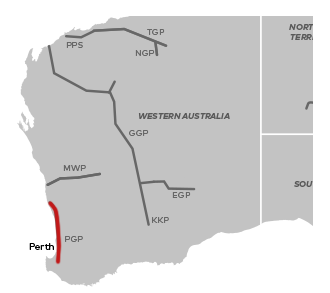
The Parmelia Gas Pipeline (PGP) is a transmission lateral pipeline located in west and south-west Western Australia. The pipeline was originally known as the Western Australian Natural Gas (WANG) Pipeline and previously owned and operated by CMS Gas Transmission of Australia. The PGP is now owned and operated by APT Parmelia Pty Ltd.  

The Parmelia Gas Pipeline is 416 km in length, has a nominal diameter of 350 mm and a capacity of 68 TJ/day. It transports gas from the Perth basin fields around Dongara (south of Geraldton) and the Carnavon Basin (via the Dampier to Bunbury National Gas Pipeline) to end-users in the Perth Metro and Pinjarra area. Gas from the PGP can be delivered into the Mondarra Gas Storage Facility, and gas withdrawn from the facility can be transported through the PGP to end-users. 

Initially there were 6 compressor stations. They have since been decommissioned and now there are no compressor stations. The following Lateral pipelines form part of the PGP:

  • ALK/ECK Lateral(suspended)
  • Perth Gas Lateral (suspended)
  • Westlime Lateral (16km) (DN100), built in 1998 (8.6TJ/d TBC)
  • MBW & WMC Lateral (3.3km) (DN100), built in 1972 (8TJ/d TBC)
  • Mondarra Lateral (0.5km) (DN150), built in 1994 (68TJ/d)
  • Canningvale Lateral (2km) (DN200), built in 2000, 13TJ/d
  • Rockingham Lateral (suspended)
  • Chandala (TiWest) Lateral (4.3km) (DN100), built in 2000, 2 TJ/d
  • Kwinana Supply Lateral (1.4km) (DN200), built in 2000, 3.3 TJ/d 
  • HiSmelt Lateral (1.4km) (DN200), built in 2003, 4.6 TJ/day
  • Rocla Lateral (0.2km) (DN100), built in 1999, 1.5 TJ/d
  • Cockburn Cement Lateral 

The PGP is currently a non-scheme pipeline, and is subject to the access regime for non-scheme pipelines under Chapter 6A of the NGL and Part 23 of the NGR.

In December 2000, an Access Arrangement submitted by the pipeline’s then-owner CMS Gas Transmission of Australia was approved under the Gas Pipelines Access (Western Australia) Act 1998. Coverage was revoked in 2002.  

Construction of the Parmelia Gas Pipeline was completed in 1971.
 

Pipeline details

State:

WA

Type:

Transmission

Capacity:

68 TJ/day

Regulation:

Non-scheme

Owner:

APA Group

Operator:

APA Group

Length:

416km

Gas Type:

Natural gas

Contact us

Title Date Documents
Minister’s decision on revocation of coverage 2002-03-13 Coverage decision
Final recommendation on application for- revocation of coverage - NCC 2002-02-19 Coverage decision
OffGAR approved access arrangement 2000-11-20 Previous access arrangement
OffGAR approved access arrangement (terms and conditions) 2000-11-20 Previous access arrangement
OffGAR approved access arrangement information 2000-11-20 Previous access arrangement
Rotate phone landscape for better viewing

WA: Kalgoorlie to Kambalda Pipeline (KKP)

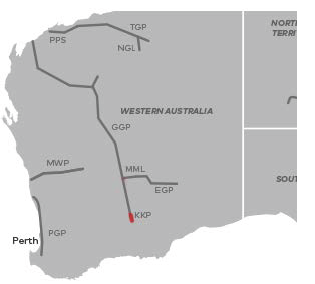
The Kalgoorlie to Kambalda Pipeline (KKP) is a transmission pipeline which transports gas from the end of the Goldfields Gas Pipeline (at Kalgoorlie South) to a nickel refinery at Kambalda, and to the inlet of the Kambalda to Esperance Gas Pipeline.
 
The KKP comprises of 44 km of high-pressure steel pipe, a nominal diameter of DN200 and has a capacity of 39.4 TJ/day. Construction of the KKP was completed in 1996.
 
The KKP is owned and operated by APA Group.  The pipeline was constructed, and is now operated, under Pipeline Licence PL 27 issued in accordance with the requirements of the Western Australian Petroleum Pipelines Act 1969.  The KKP is a covered pipeline under the access regime of the National Gas Law and the National Gas Rules, and provides light regulation services.
 

Pipeline details

State:

WA

Type:

Transmission

Capacity:

39.4 TJ/d

Regulation:

Non-scheme

Additional Regulation:

Light regulation

Owner:

APA Group

Operator:

APA Group

Length:

44 km

Gas Type:

Natural gas

Contact us

Title Date Documents
Light regulation final determination and statement of reasons 2010-06-29 Light regulation determination
Pipeline Description Pipeline description (1)
Rotate phone landscape for better viewing

VIC: Victorian Transmission System (VTS)

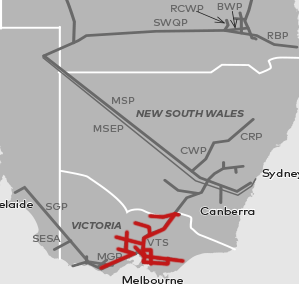
The Victorian Transmission System (VTS) has also been known as the Declared Transmission System (DTS), the Principal Transmission System (PTS) and the APA GasNet System. Since 2002, it includes the former Western Transmission System (WTS) which transported gas to Portland, Hamilton and Cobden.
 
The VTS is a transmission pipeline network owned by APA Group through its wholly owned subsidiary APA VTS Australia (Operations) Pty Ltd. APA acquired the VTS when it purchased GasNet Australia in December 2006.
 
The VTS transports natural gas within Victoria, supplying the Melbourne metropolitan area and country areas. It also supplies gas to NSW via the Interconnect with the Moomba Sydney Pipeline (MSP) at Culcairn and to South Australia via the SEA Gas Pipeline at Port Campbell. The average annual throughput of the VTS is in excess of 200 PJ per annum and it contains various diameters ranging from DN100 to DN760.
 
Construction of the VTS began in the mid-1950s and it currently consists of over 2000km of pipeline. Gas can enter or exit the system from the Longford gas plant and the VicHub in the east, Culcairn in NSW, the western underground gas storage (WUGS) facility at Iona, the SEA Gas Pipeline, Otway Gas Plant and Mortlake Pipeline through their connection to the SEA Gas Pipeline at Port Campbell, the Pakenham facility and the Dandenong LNG facility. Gas can also be injected from the Tasmanian Gas Pipeline (TasHub) into the VTS at Longford. Gas is principally sourced from offshore gas fields in the Gippsland, Bass and Otway basins.
 
The capacity of the VTS has been progressively expanded between 2014 and 2017 to transport additional gas between NSW and Victoria at Culcairn. In 2015, additional capacity on the South West Pipeline was added for gas flows from the facilities at Iona and the SEA Gas Pipeline at Port Campbell.
 
The following augmentations have been made since initial commissioning:

South West Pipeline

  • 2008 - Brooklyn Lara Pipeline construction (373 TJ/d east)
  • 2015 - Winchelsea Compressor Unit 1 installed (446 - 432TJ/d east, 92-104 TJ/d west)
  • 2018 - Brooklyn Reconfiguration and WInchelsea Unit1 bi-directional works (147-140 TJ/d west)
  • 2023 - Winchelsea Unit 2 Compressor (498 TJ/d east, 140 TJ/d west)
  • 2024 - Western Outer Ring Main (WORM) completion (523 TJ/d east 341 TJ/d west)

VNI Culcairn - Melbourne 

  • 2011 - Wollert B (2 Centaur 50 units), MAOP upgrade between Wollert and Euroa, Springhurst CS modification (17 TJ/d north)
  • 2012 - Euroa compressor installed (42 TJ/d north)
  • 2014 - 2017 Victorian Northern Interconnect Expansion Project 258km x DN400 loop (193 - 218* TJ/d north, 200 - 224* TJ/d south)  
    * increase due to WORM completion in 2024
 
The VTS operates under a market carriage system rather than a contract carriage system. It is operated by AEMO (previously VENCorp) who also operates the Declared Wholesale Gas Market in Victoria.
 
The VTS was a covered pipeline under the Gas Code and was regulated by the ACCC. Under the Gas Code, the initial access arrangements approved by the ACCC were for the PTS, WTS and VENCorp (as the PTS pipeline operator, VENCorp was considered as a service provider). Subsequently, only one access arrangement was required for the PTS and WTS when the pipelines were connected to form the VTS.
 
In addition, AEMO is no longer required to submit an access arrangement for the VTS although it remains the pipeline operator.
 
In enacting the National Gas Law and Rules, the National Gas (Victoria) Act 2008 specifies that access arrangements cannot be consolidated for any of the covered pipelines in Victoria (s. 35). This includes the VTS.
 
In addition, under the National Gas (Victoria) Act 2008, the Victorian Minister has by order published in the Victorian Government Gazette (S222, 30 June 2009) declared that the four distribution pipelines and the transmission pipeline that had been covered under the Gas Code are classified as ‘designated pipelines’. These are the AusNet Services, Australian Gas Networks (Vic), Multinet and Australian Gas Networks (Albury) gas distribution networks and the Victorian Transmission System. As a result, these pipelines remain under full regulation and cannot be the subject of a light regulation determination (under ss. 109 and 111 of the NGL).
 
The VTS remains a covered pipeline under the NGL, and is regulated under the NGR by the AER.

Pipeline details

State:

VIC

Type:

Transmission

Capacity:

In excess of 200 PJ per annum

Regulation:

Scheme

Owner:

APA Group

Operator:

APA Group

Length:

Over 2000km

Gas Type:

Natural gas

Contact us

Title Date Documents
AER - Final Decision - APA VTS Access Arrangement 2023-27 - December 2022 2022-12-09 Current access arrangement
Revised access arrangement approved by the AER 2008-11-26 Previous access arrangement
Access arrangement (GasNet) approved by the ACCC 2008-06-25 Previous access arrangement
Access arrangement information (GasNet) approved by the ACCC 2008-06-25 Previous access arrangement
Access arrangement (GasNet) varied by order of the Australian Competition Tribunal 2003-12-23 Previous access arrangement
Access arrangement information (GasNet) varied by order of Australian Competition Tribunal 2003-12-23 Previous access arrangement
Access arrangement (GasNet) approved by the ACCC 2003-01-17 Previous access arrangement
Revised access arrangement information (GasNet) approved by the ACCC 2003-01-17 Previous access arrangement
Errata to access arrangement information (VENCorp) approved by the ACCC on 13 November 2002 2002-10-25 Previous access arrangement
Access arrangement appendix 5 (VENCorp) approved by the ACCC on 13 November 2002 2002-09-16 Previous access arrangement
Access arrangement information (VENCorp) approved by the ACCC on 13 November 2002 2002-09-16 Previous access arrangement
Access arrangement appendix 2 (VENCorp) approved by the ACCC on 13 November 2002 2002-09-16 Previous access arrangement
ACCC decision on VENCorp access arrangement amendment - MSO rules 2002-07-31 Previous access arrangement
ACCC decision on VENCorp access arrangement amendment - MSO rules 2001-10-03 Previous access arrangement
ACCC decision on VENCorp access arrangement amendment - MSO rules 2001-01-16 Previous access arrangement
Access arrangement (GasNet) approved by the ACCC on 28 April 2000 1999-08-25 Previous access arrangement
Victorian gas industry MSO rules (chapters 5-11) 1998-11-30 Previous access arrangement
Victorian gas industry MSO rules (chapters 1-4) 1998-11-30 Previous access arrangement
Access arrangement (VENCorp) for the PTS approved by the ACCC on 16 Dec. 1998 1998-11-30 Previous access arrangement
Access arrangement (TPA) for the WTS approved by the ACCC on 16 Dec. 1998 1998-11-30 Previous access arrangement
Access arrangement (TPA) for the PTS approved by the ACCC on 16 Dec. 1998 1998-11-30 Previous access arrangement
Access arrangement annexures (GasNet) approved by the ACCC on 28 Apr. 2000 1999-08-25 Previous access arrangement
Access arrangement (GasNet) approved by the ACCC on 28 Apr. 2000 1999-08-25 Previous access arrangement
Revised access arrangement information (GasNet) approved by the ACCC 2004-12-15 Previous access arrangement
Revised access arrangement (GasNet) approved by the ACCC 2004-12-15 Previous access arrangement
ACCC final decision on VENCorp access arrangement revision – MSO rules 2005-02-09 Previous access arrangement
Access arrangement approved by the AER 2013-04-29 Previous access arrangement
APA Gasnet access arrangement - 2013-17 2017-02-22 Previous access arrangement
APA Gasnet access arrangement information - 2013-17 2017-02-22 Previous access arrangement
APA VTS - access arrangement - 2018-22 2017-11-30 Previous access arrangement
Previous access arrangement
VTS pipeline description Pipeline description
Rotate phone landscape for better viewing

SA: South East South Australia Pipeline (SESA)

The South East South Australia (SESA) Pipeline is a transmission pipeline operating in south-east South Australia. It is owned and operated by the APA Group.

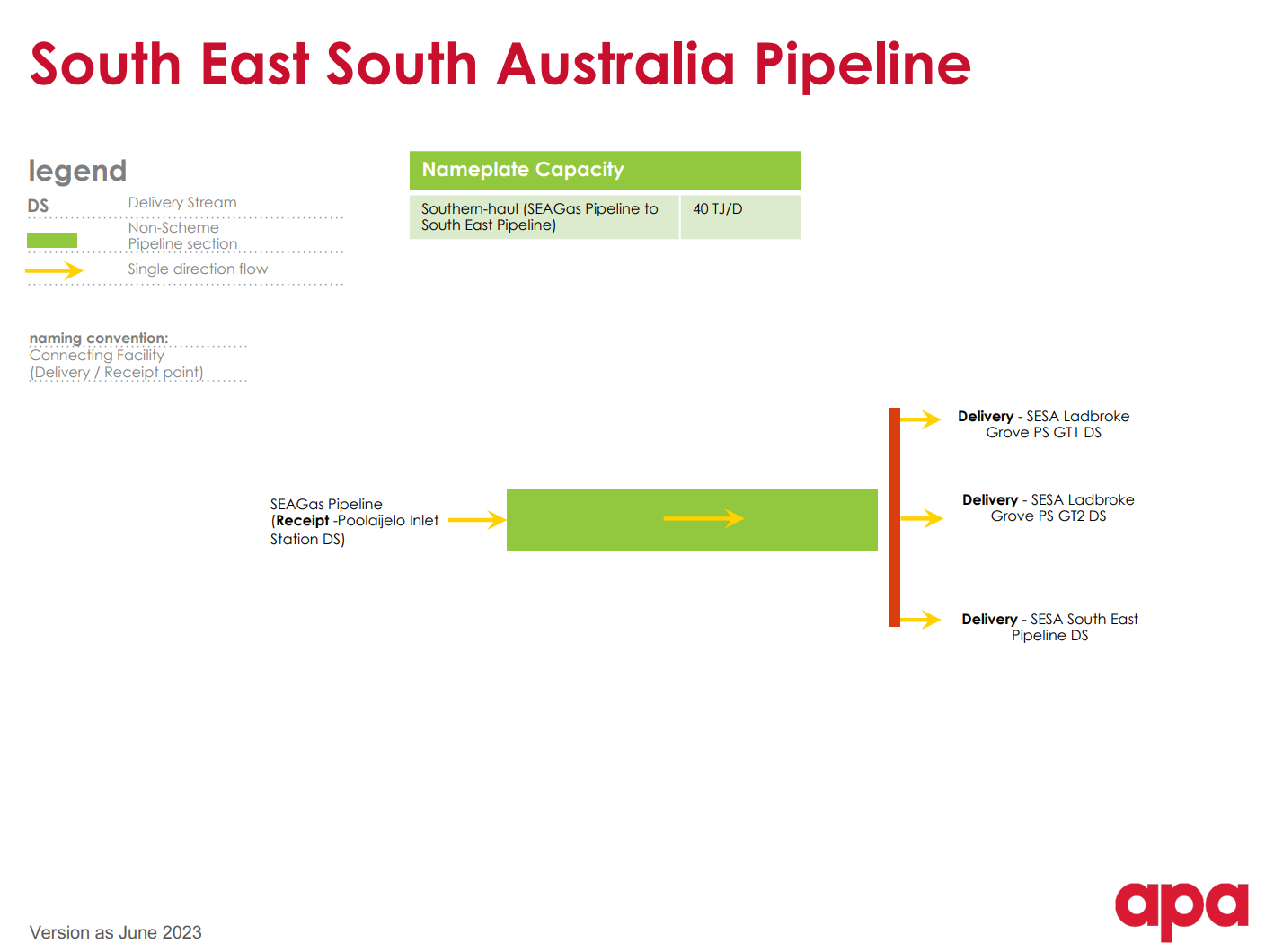
The SESA Pipeline is 45km in length, nominal diameter of DN200 and has a capacity of 40 TJ/day. The SESA Pipeline links the SEA Gas Pipeline at Poolaijelo in western Victoria to the South East Pipeline System (SEPS) at Ladbroke Grove near Penola in South Australia. Gas is sourced from the offshore Otway basin gas fields near Port Campbell and the western underground gas storage at Iona in southern Victoria.

The SESA Pipeline is currently a non-scheme pipeline, and is subject to the access regime for non-scheme pipelines under Chapter 6A of the NGL and Part 23 of the NGR. 

The SESA Pipeline was constructed in 2005. In July 2007, the APA Group acquired the SESA Pipeline when it acquired the assets of Origin Energy Networks (which included interests in Envestra and the SEA Gas Pipeline).
 

Pipeline details

State:

SA

Type:

Transmission

Capacity:

40 TJ/day

Regulation:

Non-scheme

Owner:

APA Group

Operator:

APA Group

Length:

45 km

Gas Type:

Natural gas

Contact us

Title Date Documents
South East South Australia Pipeline Description Pipeline description
South East South Australia Pipeline diagram Pipeline description
Rotate phone landscape for better viewing

QLD: Carpentaria Gas Pipeline

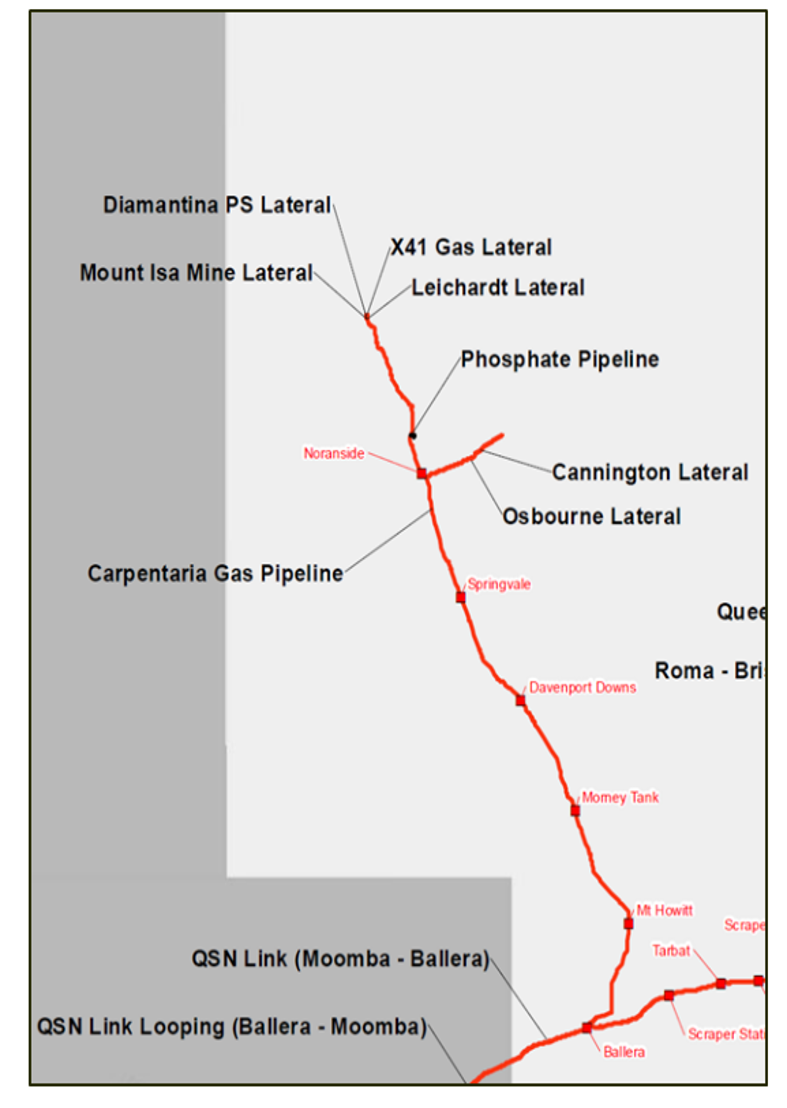
The Carpentaria Gas Pipeline (CGP) is a transmission pipeline system that extends from Ballera in SW Queensland to Mt Isa.  It transports natural gas from the Ballera gas processing facility to customers in Mt Isa – including the Mica Creek and Diamantina power stations and the surrounding Carpentaria mineral province. It is also an important link between the Northern Territory gas fields and the east coast market via the Northern Gas Pipeline (NGP). The pipeline has a length of 840km, a nominal diameter of 300 mm and a capacity of 119 TJ/day (Northern Haul) and 65 TJ/day (Southern Haul). 

The lateral pipelines that form part of the CGP are: Cannington Lateral Pipeline (CLP) (17.5 TJ/day, DN 150), Mount Isa Mines (MIM) Lateral (DN 150, 6.3km), X41 Lateral (DN 150, 0.1km), Diamantina Power Station Lateral (DPL) (0.6km), Leichardt Power Station Lateral (LPL) (0.2km). The X41 Lateral was commissioned in 2007, the DPL and LPL were comissioned in 2013.

The CGP, which was commissioned in 1998, is owned and operated by APA Group through its wholly owned subsidiaries APT Pipelines (QLD) Pty Limited and Roverton Pty Limited (known as the ‘Carpentaria Gas Pipeline Joint Venture’). When the CGP was first commissioned, South West Queensland Producers (including Santos, Origin and Delhi) had a 30 per cent stake in the pipeline (alongside APA Group’s 70 per cent) but they were bought out by APA Group in 2004, increasing its ownership stake to 100 per cent.

The CGP mainline is subject to light regulation under the NGR. It was originally a full regulation pipeline, but in 2008 the Queensland Government passed a regulation specifying that the CGP mainline would be subject to light regulation and that it cannot be the subject of a full access arrangement until 30 April 2023.

Pipeline details

State:

QLD

Type:

Transmission

Capacity:

119 TJ/day (Northern Haul); 65 TJ/day (Southern Haul)

Regulation:

Non-scheme

Owner:

APA Group

Operator:

APA Group

Length:

840 km

Gas Type:

Natural gas

Contact us

Title Date Documents
National Gas (Queensland) Regulation 2008 2008-07-01 Light regulation declaration
ACCC approved access arrangement information 2002-11-03 Access arrangements
ACCC approved access arrangement 2002-09-01 Access arrangements
CGP pipeline description Pipeline description
Rotate phone landscape for better viewing

QLD: South West Queensland Pipeline

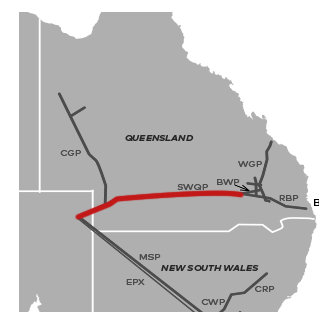
The South West Queensland Pipeline (SWQP) (also known as the Ballera to Wallumbilla Natural Gas Pipeline or the Ballera to Wallumbilla Pipeline System) is a transmission pipeline that services Wallumbilla to Moomba located in South-East Queensland/South Australia. The pipeline is owned and operated by the APA Group. 

The SWQP is 937 km in total length, and has a nominal diameter of DN400 to DN450. The Eastern-haul (Moomba to Wallumbilla) capacity is 340 TJ/day and Western-haul (Wallumbilla to Moomba) is between 487-512 TJ/day. The SWQP consists of the original pipeline that is 755 km in length, and the Queensland to South Australia/New South Wales (QSN) Link extension that is 182 km in length. In 2014, the integrated SWQP and QSN Link were reconfigured as a bi-directional pipeline.

The SWQP transports gas in a west to east direction from the Ballera gas processing plant in south west Queensland to the Wallumbilla supply hub.  At Ballera, there is a connection to the Carpentaria Gas Pipeline that supplies gas to Mount Isa. Also, along the route of the original SWQP there are connections to pipelines that supply gas to power stations at Roma and Barcaldine (Cheepie to Barcaldine Gas Pipeline).  The QSN Link provides a link between Ballera (in Queensland) and Moomba (in South Australia). At Moomba, it connects to the Moomba to Sydney Pipeline (MSP) and the Moomba to Adelaide Pipeline System (MAPS).  

The following augmentations have been made since initial commissioning :

  • 2012: Pipeline acquired. Westernhaul nameplate: 384 TJ/d
  • 2014: 3 x Mars-90 at Moomba installed. Easternhaul nameplate: 340 TJ/d
  • 2023: 1 x Mars-100 at SS2. Westernhaul nameplate: 453 TJ/d
  • 2024: 1 x Mars-100 at SS6. Westernhaul nameplate: 512 TJ/d

The SWQP is currently a non-scheme pipeline, and is subject to the access regime for non-scheme pipelines under Chapter 6A of the NGL and Part 23 of the NGR. The original SWQP was a covered pipeline and was regulated by the ACCC under the Gas Code. However, it was the subject of a Queensland Government derogation which precluded the ACCC from reviewing the reference tariff and reference tariff policy for the full forward haul service specified in the access arrangement until 2016. The reference tariff was instead approved by the Queensland Minister. In passing the National Gas (Queensland) Act 2008 to implement the NGL, the Queensland Government also passed a regulation that, among other things, specified that the SWQP was not a covered pipeline and that coverage could not be sought for the first year after the NGL commenced in Queensland. 

The original SWQP was constructed in 1996. In 2008, the QSN Link extension to the SWQP was constructed. In December 2012, the APA Group acquired the SWQP when it completed its takeover of Hastings Diversified Utilities Fund. 
 

Pipeline details

State:

QLD

Type:

Transmission

Capacity:

340 TJ/day to 512 TJ/day

Regulation:

Non-scheme

Owner:

APA Group

Operator:

APA Group

Length:

937 km

Gas Type:

Natural gas

Contact us

Title Date Documents
National Gas (Queensland) Regulation 2008 2008-07-01 Coverage declaration
Notice of AER commencing a form of regulation review into the South West Queensland Pipeline 2024 2024-02-21 Coverage declaration
Gas transportation guide - Epic Energy 2006-07-01 Previous access arrangements
ACCC approved access arrangement information - Epic Energy 2006-07-01 Previous access arrangements
ACCC approved access arrangement 2006-07-01 Previous access arrangements
ACCC approved access arrangement - Appendix 2 2006-07-01 Previous access arrangements
ACCC approved access arrangement - Appendix 1 2006-07-01 Previous access arrangements
ACCC approved access arrangement and access arrangement information 2004-11-18 Previous access arrangements
ACCC approved access arrangement 2002-06-04 Previous access arrangements
ACCC approved access arrangement - Annexure A 2006-07-01 Previous access arrangements
ACCC approved access arrangement - Annexure B 2006-07-01 Previous access arrangements
ACCC approved access arrangement - Annexure C 2006-07-01 Previous access arrangements
South West Queensland Pipeline Description Pipeline description
Rotate phone landscape for better viewing

QLD: Roma to Brisbane Pipeline (RBP)

The Roma Brisbane Pipeline (RBP) (also known as the Wallumbilla to Brisbane Pipeline) is a transmission pipeline owned and operated by APA Group through its wholly owned subsidiary APT Petroleum Pipelines Pty Limited.
 
The RBP was constructed in 1969. It transports gas between the Wallumbilla supply hub (near Roma), Brisbane and regional centres along its route. Gas is sourced from gas fields (conventional gas and coal seam gas) in the Bowen-Surat basin via the Wallumbilla supply hub, the Kogan North gas plant and the Peat lateral pipeline. These last two receipt points are located part way along the length of the pipeline. The mainline of the RBP is 438 km in length, has a nominal diameter ranging from DN250 to DN400 and is fully looped (duplicated). The Eastern-haul (Wallumbilla to Brisbane) capacity is 167 TJ/day and the Western-haul (Brisbane to Wallumbilla) capacity is 125 TJ/day. The Brisbane metro section of the pipeline is partially looped. In 2015, the RBP was upgraded to provide bi-directional flow, allowing gas to be transported from coal seam gas fields located part way along the length of the pipeline to flow to the Wallumbilla gas supply hub.
 
The following laterals are included in the RBP pipeline:
  • Gibson Island Lateral (2.6km) (DN200) (43 TJ/d)
  • Peat Lateral (121km) (DN250) (13.3 TJ/d)
  • Kogan North (0.1km) (DN200) (150 TJ/d)
  • Lytton Lateral (5.5km) (DN200) (22.3) TJ/d)

The following augmentations have been made since initial commissioning:

  • 1969 - DN250 mainline constructed; EH Nameplate = 30TJ/d
  • 1981 to 1986 - 6 x Saturn 20 compressors installed; EH Nameplate = 60TJ/d (all since decommissioned)
  • 1988 to 2022 - 400km x DN400 loop line constructed + 3 x S20 compressors moved from DN250 to DN400 pipeline; EH Nameplate = 208TJ/d
  • 2012 - Centaur 50 compressor installed at Dalby, DN400 MAOP upgrade, 6km x DN400 metro looping; EH Nameplate = 233TJ/d
  • 2015 - Installation of Run 20 for flows towards Wallumbilla, bidirectional DN400 between Wallumbilla and Kogan North; WH Nameplate = 125TJ/d
  • 2017 - Urban Encroachment Project = MOP Reduction; EH Nameplate = 211TJ/d
  • 2019 - DN250 suspended from Wallumbilla to Kogan, DN250 back fed via Bell Bird Park; EH Nameplate = 167TJ/d
     
The RBP (mainline and Peat lateral) was a covered pipeline and regulated by the ACCC under the Gas Code. It is now subject to full regulation under the NGR by the AER. 
 

Pipeline details

State:

QLD

Type:

Transmission

Capacity:

125 TJ/day to 167 TJ/day

Regulation:

Scheme

Owner:

APA Group

Operator:

APA Group

Length:

438 km

Gas Type:

Natural gas

Contact us

Title Date Documents
Roma Brisbane Pipeline Access Arrangement Revised Proposal 2022 2022-01-14 Current access arrangement
ACCC approved access arrangement 2007-03-28 Previous access arrangements
ACCC approved access arrangement information- APT 2007-03-28 Previous access arrangements
Access arrangement information 2000-11-06 Previous access arrangements
ACCC approved access arrangement 2002-09-11 Previous access arrangements
Access arrangement information 2012-08-27 Previous access arrangements
Access arrangement 2012-08-27 Previous access arrangements
Roma to Brisbane - Access arrangement - 2018 - Approved by AER 2018-03-09 Previous access arrangements
Roma Brisbane Pipeline description Pipeline description
Roma to Brisbane Pipeline - access arrangement (including terms and conditions) - August 2012.pdf 2017-02-21 Pipeline description
Roma to Brisbane Pipeline access arrangement information - August 2012 2017-02-21 Pipeline description
Rotate phone landscape for better viewing

NT: Amadeus Gas Pipeline

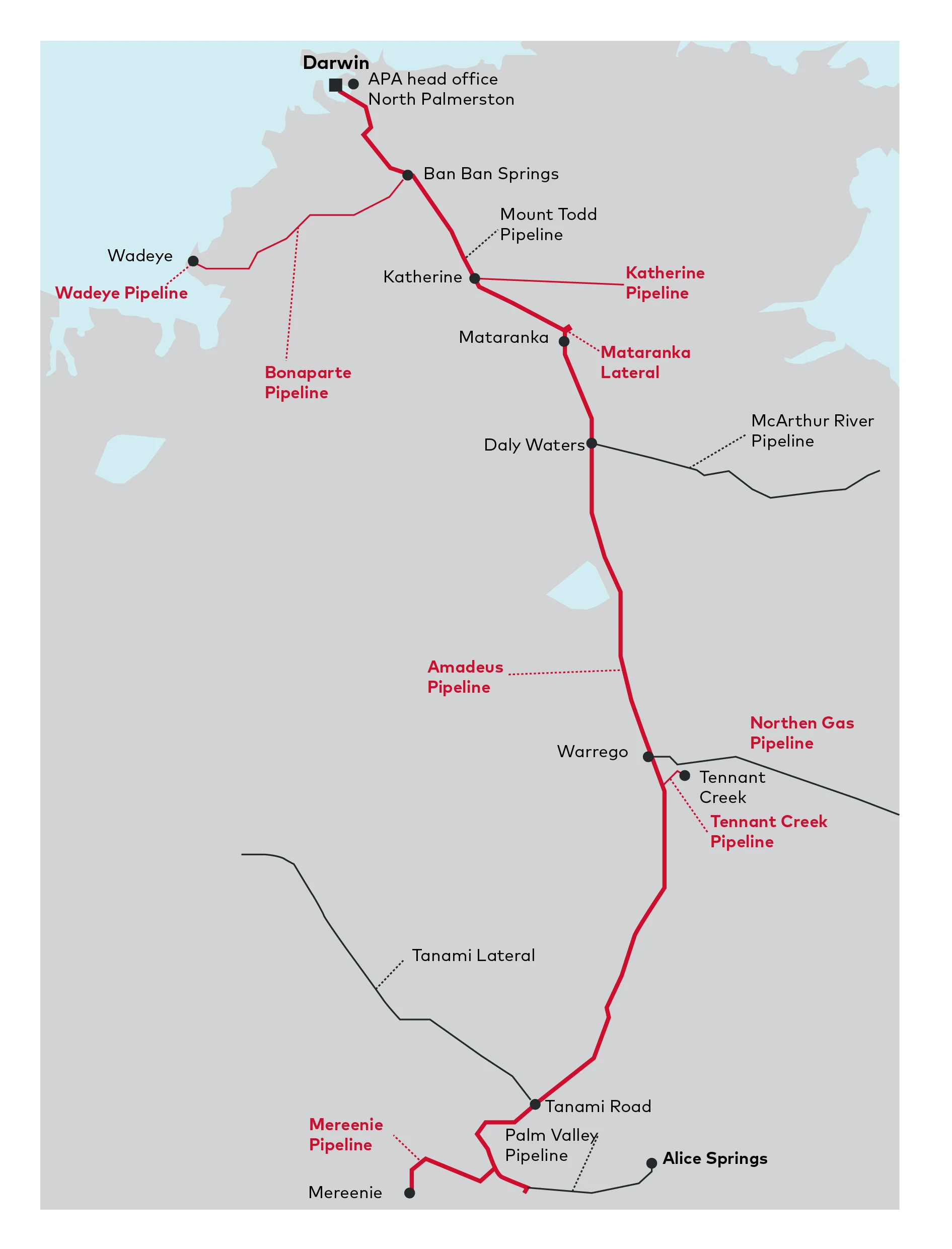
The Amadeus Gas Pipeline (AGP) (previously known as the Amadeus Basin to Darwin Pipeline, ABDP) is a transmission pipeline owned and operated by the APA Group through its wholly owned subsidiary APT Pipelines NT Pty Ltd. In June 2011, APA purchased the AGP from a consortium of financial institutions who had leased the pipeline to the Amadeus Gas Trust. Prior to June 2011, NT Gas managed and operated the pipeline for the trust and APA held a 96 per cent interest in both the Amadeus Gas Trust and NT Gas. 

The AGP was commissioned in 1986. Augmentations since the pipelines initial commissioning are: 

  • Warrego compressor was commissioned in 1996 and suspended in 2009. 
  • In 2011, the Mainline was acquired (increased nameplate capacity to 115TJ/d)
  • In 2018, the NGP connection was established (increased nameplate capacity to 165TJ/d)

The AGP pipeline transports gas to Darwin, Katherine and other locations principally to fuel electricity generation in the Northern Territory. The pipeline is 1,658 km in length and has a nominal diameter of 350mm from Palm Valley to Mataranka, 250mm from Mereenie to Tyler Pass and 300mm from Mataranka to Darwin.

The lateral pipelines that form part of the AGP pipeline are: 

  • Mt Todd Lateral (suspended)
  • Mataranka Lateral (suspended)
  • Elliot Lateral (4km) (commissioned in 1989) (DN50) (0.4 TJ/d)
  • Katherine Lateral (5.45km) (commissioned 1986) (DN100) (10.4 TJ/d)
  • Tennant Creek Lateral (24km)(commissioned 1986) (DN100) (3.6 TJ/d)
  • Mereenie - Tylers Pass Lateral (116km) (commissioned 1986)(DN250) (60 TJ/d) 

When built, gas flowed northwards to Darwin from the Palm Valley and Mereenie gas fields in the Amadeus Basin. However, since 2008 natural gas from the Blacktip gas field in the Bonaparte basin also feeds into the AGP from the Bonaparte Gas Pipeline. This gas flows north to Darwin and south towards Alice Springs. The AGP was initially subject to regulation as a covered pipeline under the Gas Code by the ACCC. It is now subject to full regulation by the AER under the NGR.

Pipeline details

State:

NT

Type:

Transmission

Capacity:

165TJ/d

Regulation:

Scheme

Owner:

APA Group

Operator:

APA Group

Length:

1658 km

Gas Type:

Natural gas

Contact us

Title Date Documents
AER approved access arrangement - Amadeus Gas Pipeline April 2021-26 2021-12-14 Current access arrangement
ACCC approved access arrangement information 2003-02-05 Previous access arrangement
ACCC approved access arrangement 2003-02-05 Previous access arrangement
Previous AER approved access arrangement 2011-07-27 Previous access arrangement
AER approved access arrangement information 2011-07-27 Previous access arrangement
Approved access arrangement for the Amadeus Gas Pipeline 2021 to 2026 Previous access arrangement
Proposed revocation and substitution of Amadeus Gas Pipeline transmission access arrangement 2016-2021 Previous access arrangement
Amadeus Gas pipeline description Pipeline description
Rotate phone landscape for better viewing

NSW: Moomba to Sydney Pipeline (MSP)

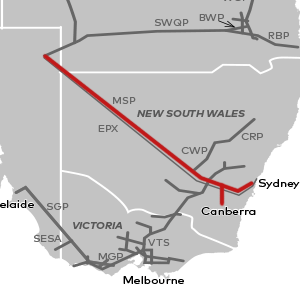
The Moomba to Sydney Pipeline (MSP) is a transmission pipeline that operates across NSW. The pipeline is owned and operated by the APA Group.  The pipeline is 2081 km in length and has a forward haul capacity of 489 TJ/day and a back haul capacity of 120 TJ/day. The pipeline links the Cooper basin gas fields at Moomba in South Australia to gas distribution systems in Sydney, Newcastle, Wollongong, Canberra and some NSW regional centres. 
View more

The Moomba to Sydney Pipeline (MSP) is a transmission pipeline that operates across NSW. The pipeline is owned and operated by the APA Group. 

The MSP mainline (Moomba to Wilton) is 1300 km in length, a nominal diameter of DN 850, a forward-haul capacity of 565 TJ/day and a back-haul capacity of 193 TJ/day. The pipeline links the Cooper basin gas fields at Moomba in South Australia to gas distribution systems in Sydney, Newcastle, Wollongong, Canberra and some NSW regional centers. In other sections of the MSP the capacity is the following: Young to Culcairn (195 TJ/d) and Culcairn to Young (200 TJ/day).

Some parts of the pipeline vary in diameter as follows:

  • Dalton to Canberra - 57.9km, DN250 
  • Young to Lithgow - 212.5km, DN150 
  • Bathurst Spur - 2.2km, DN100
  • Browns Creek to Orange - 23.9km, DN100 
  • Brewongle to Oberon - 30.9km, DN150
  • Young to Wagga Wagga - 131km, DN300 
  • Wagga to Bethungra North (loop) - 61km, DN450 
  • Cootamundra Spur - 2.8km, DN80
  • Junee to Griffith/leeton - 179km, DN150
  • Junee Spur - 1.1km, DN100
  • Culcarin to Wagga Wagga - 87km, DN450
  • Young loop - 39km, DN450  
  • Bethungra loop - 31km, DN450 

Since 2008, with the completion of the QSN Link which connects to the MSP at Moomba and the change in flow direction on the South West Queensland Pipeline (SWQP), gas can also be sourced from conventional and coal seam gas fields in the Bowen-Surat basin in Queensland. In December 2015, the MSP became bi-directional. A new receipt point at Wilton connected to Jemena Eastern Gas Pipeline and provided the ability to flow gas north to Moomba.

The MSP is subject to two different forms of regulation:

  • The Moomba-Marsden segment of the mainline and the Wagga Wagga-Culcairn lateral are non-scheme pipelines and subject to the access regime for non-scheme pipelines under Chapter 6A of the NGL and Part 23 of the NGR. 
  • The Marsden-Wilton segment and the other laterals (Dalton-Canberra, Young-Lithgow-Bathurst, Young-Wagga Wagga, and Burnt Creek-Griffith) are classified as covered and subject to light regulation under the AER. 
     

Background

The pipeline was initially subject to regulation by the ACCC as a covered pipeline under the Gas Code. It has been the subject of two coverage revocation processes and a light regulation determination. 

First, in 2000 the service provider was unsuccessful in seeking revocation of coverage for most parts of the pipeline. The NCC, and then subsequently the Minister, rejected the application. 

Revocation for certain parts of the MSP were subsequently sought by the service provider. In 2002 the NCC again recommended against revocation. However, the Minister’s decision was to revoke coverage of the Moomba-Marsden segment of the mainline. The remainder of the MSP was to continue to be a covered pipeline subject to full regulation with the exception of Young-Culcairn (part the Interconnect) which had not been covered. 

In 2008, the NCC determined to change the form of regulation applied to the covered part of the MSP from full regulation to light regulation.

The MSP was constructed in 1976 to service the NSW gas market. It comprises a mainline from the Moomba processing plant to Wilton near Sydney and four lateral pipelines (Young to Orange and Lithgow, Young to Wagga Wagga, Junee to Griffith and Dalton to Canberra). With the completion of the NSW-Victoria Interconnect between Wagga Wagga and Culcairn in 1998, gas can be transported bi-directionally between NSW and the Victorian Transmission System. The capacity between NSW and the Victorian Transmission System has been progressively expanded between 2014 and 2017 to transport additional gas between NSW and Victoria. The MSP is also interconnected with the Central West Pipeline (CWP).

The following augmentations have been made since initial commissioning:

  • 1974-1976: Mainline constructed. Nameplate capacity: 280 TJ/d
  • 1986: Bulla Park compressor installed. Nameplate capacity: 397 TJ/d 
  • 1989: Young compressor installed. Nameplate capacity: 480 TJ/d
  • 2004-2006: Derating due to stress corossion cracking. MOP Reduction.
    Bulla Park series operation. Nameplate capacity: 400 TJ/d 
  • 2008: Repairs to increase MOP Moomba - Bulla Park MOP to  5000 kPa, MW300 Regulator installed. Nameplate capacity: 420 TJ/d
  • 2010: Repairs to increase MOP Moomba - Bulla Park MOP to  5200 kPa, Bulla - Young MOP 5500 kPa, Young Compressor in series. Nameplate capacity: 439 TJ/d
  • 2017: VNIE loop completed. North bound flows from Culcairn increases MSP capacity. Nameplate capacity: 489 TJ/d 
  • 2019: Moomba Compressors Low Pressure Lift (Mars 90), Installation of Regulator at Young, Bulla Park bi-directional. 
    Wilton - Moomba capacity: 193 TJ/d
    Culcairn - Young capacity: 200 TJ/d
  • 2019: SHEX1 - Young Wagga Compressor Upgrade Project. 
    Young - Culcairn capacity: 195 TJ/d
  • 2020: Nameplate capacity redeclared: 446 TJ/d  based on south bound flows from Moomba.
  • 2023: 1x Mars -100 at MW880. Nameplate capacity: 475 TJ/d
  • 2024: 1x Mars-100 at MW433. Nameplate capacity: 565 TJ/d


View less

Pipeline details

State:

NSW

Type:

Transmission

Capacity:

193 TJ/d to 565 TJ/d

Regulation:

Non-scheme

Additional Regulation:

Part of the MSP mainline and some connecting lateral pipelines are scheme pipelines, other parts are non-scheme

Owner:

APA Group

Operator:

APA Group

Length:

1300 km

Gas Type:

Natural gas

Contact us

Title Date Documents
Light regulation final decision and statement of reasons – NCC 2008-11-19 Light regulation determination
Ministerial decision on revocation of coverage 2000-10-16 Coverage decision
Ministerial decision on revocation of coverage 2003-11-19 Coverage decision
Ministerial statement of reasons on revocation of coverage 2003-11-19 Coverage decision
Final recommendation on revocation of coverage – NCC 2002-11-01 Coverage decision
Final recommendation on revocation of coverage – NCC 2000-09-01 Coverage decision
Amended access arrangement by order of the Australian Competition Tribunal 2005-05-19 Previous access arrangements
Access arrangement drafted and approved by the ACCC 2003-12-08 Previous access arrangements
NSW Moomba Sydney pipeline description Pipeline description
Rotate phone landscape for better viewing
Subscribe to APA Group