Retail

News Topic ID
28

Proposed changes to make energy switching easier for life support customers

06 August 2020

The Australian Energy Market Commission is seeking input on a proposal to help consumers needing life support equipment such as kidney dialysis machines to shop around for better deals.

The consultation follows a request from the Energy and Water Ombudsman of New South Wales (EWON) to remove barriers to energy switching for people who need life support equipment.

Under current rules, in some situations, when life support customers move homes or change retailer, they need to provide a new medical certificate.

EWON considers that the costs of securing a new medical certificate each time may deter life support customers from switching.

EWON has requested changes to the National Energy Retail Rules (NERR) to allow outgoing retailers or distributors to share relevant medical information with a new retailer or distributor selected by the customer.

The consultation paper explores EWON’s proposed solution, the issues and implementation challenges. The AEMC has long advocated for giving consumers options in how they use energy and allowing them to actively engage with the retail energy market by shopping around for the best value-for-money deal. We will explore the issues and invite stakeholders to provide feedback on the consultation paper by 3 September 2020.


Media: Kellie Bisset, Media and Content Manager, 0438 490041

Have your say on technical standards for distributed energy resources like rooftop solar

25 June 2020

The AEMC is investigating how small energy systems like rooftop solar can best contribute to Australia’s renewable energy future without risking system security.

Releasing its consultation paper today, the Commission has called for your views on the implications of setting minimum technical standards for distributed energy resources (DER) such as rooftop solar and batteries.

The rule request put forward by the Australian Energy Market Operator (AEMO), proposes that it set minimum standards that must apply to all new connected rooftop solar systems, household and business battery systems, and electric vehicles, delivering power to the grid.

Distributed energy resources are consumer-owned devices that, as individual units, can generate or store electricity or have the 'smarts' to actively manage energy demand. These devices will play an increasingly important role in meeting Australia’s energy needs into the future.

AEMC Chief Executive Benn Barr said there are currently no national standards enforced through the National Electricity Rules for this type of equipment.

“Uncertainty about the quality and performance of these small systems means the market operator is increasingly under pressure to restrict the energy generated by rooftop solar from entering the grid to avoid destabilisation,” Mr Barr said.

“It is clear that system security issues need to be addressed to avoid this scenario as rooftop solar penetration is expected to reach 14.64 GW total - an amount that could meet upwards of 40 per cent of underlying demand by 2025.

“But the introduction of new technical standards into the National Electricity Rules framework may have significant cost implications for both the installation of new systems and system monitoring into the future.”

“AEMO welcomes consultation on the inclusion of DER technical standards for the NEM," said AEMO Managing Director and CEO Audrey Zibelman.

"With DER now the largest source of generation, technical standards will be critical to delivering better outcomes for consumers, enabling new markets to develop and maintaining power system security.”

The AEMC consultation paper outlines key questions to be addressed, including:

  • is the creation of a subordinate instrument for AEMO to set the initial minimum technical standard the most efficient way to address system security issues?
  • in the absence of a long-term governance framework, should AEMO's power to set the initial minimum technical standard be limited to addressing immediate concerns of voltage ride through and provision of an emergency backstop?
  • should the life of the initial subordinate instrument be limited until such a time when a broader governance framework for the DER minimum technical standard comes into place?
  • where and how should the standards be applied and who will monitor compliance?
  • who should bear the costs of implementing and complying with these new standards?

Market bodies working together

This rule change request is part of a coordinated program of work to integrate distributed energy resources in a way that benefits all energy users.

A broad collaboration of consumer and industry associations, energy market authorities, the Energy Security Board and government agencies are well underway with this work.

The AEMC is working with 12 other bodies to support Australia’s evolution toward a distributed energy system that is secure, reliable, resilient, affordable and efficiently integrates and uses customers’ energy resources, enabled through distributed energy markets. Considerable work has been underway since the AEMC’s 2019 Economic Regulatory Framework Review (ENERF) highlighted that networks are becoming a two-way platform for customers to use the grid.

About this reform process

This rule change request seeks to address some imminent system security issues caused by DER connections as identified by AEMO. The AEMC will consider this request requiring AEMO to create a subordinate instrument for a minimum technical standard for distributed energy resources and a definition of DER in the energy rules. We will consult with stakeholders before publishing a final determination in December.

While the AEMC’s rule change process is underway, AEMO will consult on DER technical standards details. AEMO is expected to complete its consultation process by December 2020.

And a new governance framework to support nationally consistent minimum technical standards for DER will be developed by the Energy Security Board.  The preferred long-term governance framework is expected to be recommended to the COAG Energy Council in October 2020.

Together, these three projects combine to create a new, ongoing framework for the development of the minimum capabilities for distributed energy resources hardware, data and communications standards in a manner that achieves efficient outcomes and supports broader, national alignment on small energy system integration.

Media: Kellie Bisset, Media and Content Manager M: 0438 490041 T: (02) 8296 7813

About the AEMC

The Australian Energy Market Commission is the rule maker, market developer and expert adviser to governments on energy. It protects consumers and achieves the right trade-off between cost, reliability and security.

AEMC starts annual review of the electricity network economic regulatory framework

04 June 2020

The AEMC is today commencing its annual review of the electricity network economic regulatory framework (2020 Review).

In this year’s review, we will identify a priority list of issues relevant to the electricity sector's transformation that may require attention or reform – beyond the integration of distributed energy resources – as the electricity sector transformation continues.

Last year’s review of the future of the electricity grid focussed intensively on distributed energy resources and detailed a series of key recommendations and actions required to integrate the increasing uptake of distributed energy resources into the national electricity market (NEM) in ways that benefit everyone who uses the power system.

There is a significant program of work under way to integrate distributed energy resources into the electricity system and many of the recommendations from last year’s review have also commenced.

With all this work underway, it is timely for us to engage with stakeholders on other emerging issues.

The review will also provide an update on the implementation of recent reforms and report on the AEMC's monitoring of network businesses' key performance indicators.

An approach paper has been released today explaining the AEMC’s approach for this year’s review and seeking your feedback on issues we propose to consider as part of the 2020 Review.

Those issues include:

  • Dealing with large transmission investment and contingent projects in the context of AEMO’s Independent System Plan (ISP)
  • Risk allocation between distribution networks and consumers
  • The need for enhanced consumer engagement.

The approach paper also provides stakeholders with visibility over the broader work program that is being undertaken by the AEMC in relation to network-related issues arising from the transformation of the electricity sector.

Submissions to the approach paper close on 2 July 2020. The final report is due for publication on 1 October 2020.


Media: Kellie Bisset, Media & Content Manager, 0438 490 041 or (02) 8296 7813

AEMC Initiated Rules – Minor changes 2 2020

28 May 2020

On 28 May 2020, the AEMC made the National Electricity Amendment (Minor changes 2) Rule 2020 No. 8, the National Gas Amendment (Minor changes 2) Rule 2020 No. 3 and the National Energy Retail Amendment (Minor changes 2) Rule 2020 No. 4. These Rules were made by the AEMC to correct minor errors and make non-material changes to the National Electricity Rules (NER), National Gas Rules (NGR) and the Energy Retail Rules (NERR). As with previous AEMC initiated rules, these minor corrections and non-material changes will make the rules clearer to stakeholders.

Media: Kellie Bissett, Media and Content Manager, 0438 490 041 or (02) 8296 7813

Providing certainty on meter installation and repair timeframes for customers with shared fusing

21 May 2020

Today the Australian Energy Market Commission AEMC made a rule to provide customers impacted by shared fusing arrangements with certainty of meter installation timeframes.

Shared fusing is when customers in separate premises share electricity connections, for example in some apartment blocks. This means the supply of all customers who share the connection may need to be interrupted for metering work.

In these circumstances, if a customer’s supply cannot be interrupted without interrupting supply to one or more other customers, then the current metering installation timeframes do not apply – potentially leaving customers without a new installation or service for an undefined time.

To address this gap, today’s final rule introduces new timeframes for meter installations where a customer shares fusing.

When a customer who lives in a premises with shared fusing requests a new meter, retailers will be required to install the meter by a date agreed with the customer, or if no date is agreed, within 30 business days of discovering the shared fusing.

Similarly, a metering coordinator will be required to fix a malfunctioning meter within 30 business days of the shared fusing being discovered.

When a retailer or metering coordinator asks a distribution business to carry out a planned interruption to install or repair a meter, the distribution business must carry out the interruption on an agreed date, or if no date is agreed, within 25 business days of the request. This provides certainty to customers and market participants to meet timeframes.

The final rule clarifies that retailers can arrange a supply interruption to any of their own customers for the purpose of installing, maintaining, repairing or replacing metering equipment, not just the customer receiving the new meter.

To reduce uncertainty in future installations, the final rule includes a requirement for information sharing by retailers and/or metering parties with the distribution business. Once shared fusing arrangements are identified, the party must share the information with other market participants as soon as practicable.

Media: Kellie Bisset, Media and Content Manager, 0438 490 041 or (02) 8296 7813 

Draft rule to reduce meter installation and repair timeframes for customers with shared fusing

19 December 2019

The Australian Energy Market Commission is calling for submissions on a draft rule to give customers with shared fusing greater certainty over when their meter will be installed or replaced.

Shared fusing is when customers in separate premises share electricity connections, for example in some apartment blocks. This means the supply of all customers who share the connection may need to be interrupted for metering work.

In these circumstances, if a customer’s supply cannot be interrupted without interrupting supply to one or more other customers, then the current metering installation timeframes do not apply.

To address this gap, today’s draft rule introduces new timeframes for meter installations for customers with shared fusing.

When a customer requests a new meter, retailers will be required to install the meter within 30 business days of the shared fusing being discovered.

Similarly, a metering coordinator will be required to fix a malfunctioning meter within 30 business days of the shared fusing being discovered.

When a retailer or metering coordinator asks a distribution business to carry out a planned interruption to install or repair a meter, the distribution business must carry out the interruption within 25 business days of the request. The current rules for notifying customers about a supply interruption would apply - that is, distribution businesses must obtain consent from all affected customers or provide four business days’ notice.

The draft rule clarifies that retailers may arrange a supply interruption to any of their own customers with shared fusing for the purpose of installing, maintaining, repairing or replacing metering equipment, not just the customer receiving the new meter.

To help minimise site visits for future installations, the draft rule also includes a requirement for retailers and metering parties to notify the distribution business as soon as practicable of any shared fusing situations they have identified. This information must then be shared with market participants.

Submissions on the draft determination and draft rule are due by 13 February 2020.

Media: Kellie Bisset, Media & Content Manager, 0438 490 041; (02) 8296 7813

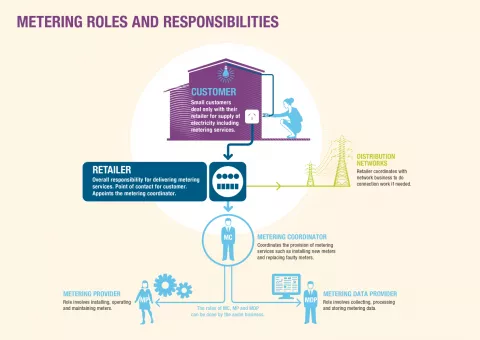
Background: Metering roles and responsibilities:

Thumbnail

Powering the grid of the future

26 September 2019

by AEMC Chairman John Pierce
Published on 26 September 2019 in the Australian Financial Review

Australians are at the forefront of a technological revolution in energy – which has the potential to significantly improve our day to day lives and bring down power bills. 

Households and businesses are now able to produce and store energy through rooftop solar and batteries. Digital appliances and home automation are creating new and exciting opportunities for efficiently managing energy demand.

To maximise the benefits of these technological developments, the Australian Energy Market Commission has today made a package of recommendations through our Grid of the future review, undertaken at the request of the COAG Energy Council. 

At a high level, the Commission is recommending that the electricity network be fundamentally reoriented away from a one way supply chain model to a platform for energy production, consumption, storage and trading.  We are proposing to give energy businesses more tools and opportunities to understand the impacts of these new technologies on their networks.

Behind the meter, there has been a surge in solar PV and battery storage. More than two million homes are now energy producers as well as consumers. Unfortunately, networks still largely charge for energy consumed and not necessarily the services consumers will now require. 

But with the increased cost competitiveness of battery storage and the growth of electric vehicles, there is an opportunity to consider concepts of access pricing and cost-reflective or customer reward pricing. As an example, instead of paying for energy consumed, customers would pay for access to the services they need from the network and be rewarded where they can provide services back to the grid. Adoption of these types of pricing principles would allow consumers to benefit by storing excess power in the middle of the day and selling it into the grid or using it in the evening. 

Such a reform would not only benefit customers with rooftop solar and batteries. By more efficiently utilising the energy produced by embedded generation, the demand on the electricity network is reduced. Batteries can also provide network services that help improve reliability and security for everyone and the households that can provide these services should be rewarded accordingly. 

Over time, this would reduce the amount of money required to service peak demand and therefore reduce costs and prices for all consumers while maintaining reliability and security. 

Conversely, if we don’t make changes to the way networks operate, consumers will bear the cost of distributed energy resources being poorly integrated into the system. A market that does not give customers choice and rewards will drive up costs. For example, electric vehicles could add to peak demand instead of smoothing it, and low cost solar generation could be unnecessarily constrained off.

So while the potential is there for these technological advances to benefit consumers it is not inevitable. The AEMC’s recommendations are needed to convert potential benefits into actual ones.

The unprecedented technological change is not just a supply side story. There are dynamic shifts in technology occurring on the demand side. 

The digitalisation of homes and businesses means new business models are emerging that allow demand to respond in real-time based upon system conditions and pricing signals. A digitally-enabled appliance can be managed remotely in real time by customers or energy service providers on their behalf. There means a much greater ability for demand response to be used as a substitute for new supply.

Demand response and supply-side options are economic substitutes. At times of low demand where there is surplus generation capacity, it is generally more economic for generation to be used to meet customers’ electricity needs.

However, at times of high demand, the cost of supplying an extra unit of electricity is likely to be significant. It is very costly to invest in generation and network infrastructure when it is only used for a few hours each year to service peak demand. Therefore, the ability for customers to choose to manage demand in a manner that is suitable to them is an effective tool in the energy market’s toolkit.

Earlier this year, the AEMC made a draft determination to introduce a wholesale demand response mechanism into Australia’s national electricity market (NEM). This would allow customers to embrace digital and other technologies to bid demand reductions directly into the wholesale NEM. 

The benefits would be two fold – customers that offer their demand response can benefit from reduced energy bills – and all other customers would benefit from avoided expenditure on infrastructure to meet increased peak demand.

New technologies and business models are fundamentally reshaping Australia’s electricity markets. It is important that regulatory frameworks continue to evolve to ensure that consumers can maximise the benefits from this technology transition. To this end, we are working in partnership with the Australian Energy Markey Operator and the Australian Energy Regulator on options for reforms as part of the Energy Security Board’s post-2025 process. 

The AEMC’s recommendations for regulating electricity networks form a bedrock on which to move forward. Ultimately, the grid must transition in a way that meets the national energy objectives – the long-term interests of consumers.
Wholesale demand response technical working group discussion notes now available

26 April 2019

The AEMC has published discussion notes from the second meeting of the technical working group, which is helping to inform the AEMC’s assessment of three rule change requests related to facilitating wholesale demand response in the National Electricity Market (NEM).

Members of the group are experts from consumer groups, large consumers, network businesses, retailers, technology providers, market bodies and AEMO. The attendees of the meeting are listed below.

Member

Organisation

Mark Byrne Total Environment Centre
Bridgette Carter Bluescope
Dan Cass The Australia Institute
Nabil Chemali Flow Power
Chris Cormack AEMO

Alex Cruickshank
Oakley Greenwood (representing Lance Hoch, Oakley Greenwood)
Emma Fagan Tesla
Joel Gilmore Australian Energy Council
Rebecca Knights South Australia Government
Matt Lady AER
Craig Memery Public Interest Advocacy Centre
Ben Pryor ERM Power
Jenessa Rabone AGL
Claire Richards Enel X
Jon Sibley ARENA
Georgina Snelling EnergyAustralia
Ben Verdon Energy Queensland

At the meeting on 15 April 2019 the group discussed potential options for facilitating wholesale demand response in the national electricity market and the issues that could arise from each option including:

  • potential regulatory changes that would require retailers in the NEM to offer standardised demand response products to customers
  • baselines for wholesale demand response including:
    • details on the design objectives for baselines 
    • three high level approaches for determining baselines (categorised according to whether settlement and baselines are undertaken centrally or not)
  • whether demand response can be treated equivalently to generation, particularly in relation to scheduling in the wholesale market.

These rule change requests are being progressed as part of the Commission’s broader Reliability work plan.  A draft determination on the rule change request is due to be published in July 2019.

Media: Prudence Anderson, Communication Director, 02 8296 7817; 0404 821 935 
 

Industry workshop to help consumers upgrade to smart meters

13 December 2018

A joint market bodies workshop by the AEMC, AER and AEMO to make it easier and faster for consumers to upgrade to smart meters was held in Adelaide last week.

Around 45 industry and government representatives attended the workshop, including retailers, network businesses, metering businesses, Master Electricians Australia, the National Electrical and Communications Association, ombudsmen and state government officials. 

The workshop focussed on improving the meter installation process in situations where it is difficult to isolate the meter, such as in some older apartment blocks. There was broad consensus that a lack of coordination and information sharing is making it difficult for those doing the work to identify and fix problems early in the process.

Participants at the workshop agreed on a set of actions, including a potential  rule change request to the AEMC to streamline the process for undertaking planned outages in situations where many customers will be affected. 

AEMO will also consider opportunities for more information sharing about individual meters through its NMI standing data review. This review is currently looking at standardising and simplifying the metering data that AEMO holds and makes available to industry.

The workshop followed the AEMC’s rule made last week that sets new deadlines for retailers to install electricity meters. The new rule, which starts in February, will address many of the delays that some homeowners and small businesses have been experiencing when they seek to upgrade or install a new meter.

Media: Bronwyn Rosser, Communication Specialist, 0423 280 341, (02) 8296 7847

BACKGROUND

New deadlines for installing electricity meters

Almost 600,000 smart meters have been installed in NSW, South Australia, Queensland, ACT and Tasmania, since changes were made by the AEMC to enable consumers to request smart meters directly from their retailers.

While this roll-out has been smooth for the vast majority of consumers, in some cases retailers have been too slow to have new meters installed, causing issues for homeowners particularly in cases where this prevents them from moving into their new homes. 

In December 2018 the AEMC made a rule that gives customers more control over when their electricity meter will be installed or upgraded. Retailers will have to provide new smart meters by a date agreed with customers. If no timing is agreed, retailers must install new meters within six working days after a property has been connected to the network.

If customers want to swap their old meter for a smart meter, retailers will have to agree on an installation time with the customer. If they cannot reach agreement, the retailer must make sure the work is done within 15 business days. Replacing a faulty meter must also be done within 15 business days. 

Failure to meet these deadlines could result in fines of up to $100,000 for each incident, and $10,000 for each day of delay.

It is part of the AEMC’s consumer action plan to help give consumers more control over their energy bills.

Victoria

As a result of a separate Victorian government rollout, almost all Victorian consumers already have advanced meters that were installed by distribution businesses. The Victorian government has made significant derogations from the metering provisions in the national rules.

Benefits of smart meters

Smart meters help get the most out of new technologies like rooftop solar, storage and energy efficient appliances. For example, smart meters enable ‘demand response’. This is when consumers are paid to use less energy by switching off appliances or drawing power from their solar panels or battery storage instead of the grid. This helps the power system cope with heatwaves and avoid blackouts. Smart meters can also give information about energy consumed by new ‘smart’ appliances – making it easier for consumers to move their use to off-peak times if they choose.

Making retailers meet new deadlines for installing electricity meters

06 December 2018

The Australian Energy Market Commission (AEMC) today made a rule that gives customers more control over when their electricity meter will be installed or upgraded. 

Retailers will have to provide new smart meters by a date agreed with customers. If no timing is agreed, retailers must install new meters within six working days after a property has been connected to the network.

If customers want to swap their old meter for a smart meter, retailers will have to agree on an installation time with the customer. If they cannot reach agreement, the retailer must make sure the work is done within 15 business days. Replacing a faulty meter must also be done within 15 business days. 

Failure to meet these deadlines could result in fines of up to $100,000 for each incident, and $10,000 for each day of delay.

AEMC Chief Executive, Anne Pearson, said the changes will give consumers more certainty over when their meters will be installed, and provide a strong incentive for retailers and network businesses to achieve the new mandatory timeframes.

“Hundreds of meters are being rolled out every day without any problems for most people,” Mrs Pearson said.

“More than 500,000 smart meters have been installed in NSW, South Australia, Queensland, ACT and Tasmania, since changes were made by the AEMC to enable consumers to request smart meters directly from their retailers.

“While this roll-out has been smooth for the vast majority of consumers, in some cases retailers have been too slow to have new meters installed, causing issues for homeowners particularly in cases where this prevents them from moving into their new homes.  

“That’s not good enough, so we’re stepping in to give consumers more certainty with enforceable new timeframes.”

Mrs Pearson said customers in South Australia have been most affected, as they have been particularly quick to request smart meters. Communications between the network and retailers must also be improved in that jurisdiction.

“The take-up of smart meters has been faster than anticipated, driven by both consumers and energy companies,” Mrs Pearson said.

“Giving people access to smart meters, which they didn’t have in the past, means they can better control their energy use and costs, and will make those vexed estimated meter reads a thing of the past.”

The rules place new obligations on network businesses as well as retailers. If networks are doing connection work for the customer, they will need to notify retailers as soon as they have finished, so the meter can be installed promptly. They must also use AEMO’s already established B2B e-hub, an industry-wide online booking system, to coordinate with retailers on key stages of the installation process.

Retailers and networks will be required to meet the new timeframes from 1 February 2019. The AEMC is also recommending the COAG Energy Council approves new civil penalties to protect customers if retailers or network businesses do not meet these new deadlines. 

In the meantime, regulators, ombudsman schemes and state governments will continue to work with retailers and distribution businesses to clear the backlog so customers get their new meters quickly. This includes a joint AEMC, AEMO and AER workshop on improving installation processes for industry, retailers and consumers representatives in Adelaide on 7 December 2018.

Media: Prudence Anderson, Communications Director, 0404 821 935, (02) 8296 7817
 

Subscribe to Retail