Corporate

News Topic ID
21

AEMC Residential Electricity Price Trends report to be published in mid-2023

01 December 2022

The Australian Energy Market Commission (AEMC) will publish its next Residential Electricity Price Trends report in mid-2023.

This year has seen a period of unprecedented conditions for Australia’s electricity markets, such as price increases as a direct result of global events and fuel prices and the suspension of the wholesale market in June 2022.

Timing the delivery of the report for mid-2023 will allow the AEMC’s experts to provide a more detailed consideration of the unique combination of market forces, changes and volatility of recent months. Previously reports have been published towards the end of a calendar year.

The AEMC is also investigating ways to make the report more useful for stakeholders into the future.

The AEMC remains focused on providing a framework for stable and affordable electricity prices and ensuring the market is working in the best interests of Australian households and businesses.

In recent months, the AEMC has delivered significant work on a number of major reforms and reviews for the sector including an amendment to the Administered Price Cap, the Transmission Planning Investment Review, the Review of the Regulatory Framework for Metering Services.

Media: Georgina Kentwell, 0411 043 964, media@aemc.gov.au

Making the power system stronger to keep the lights on and lock in new technologies

17 December 2020

Merryn York

Acting Chair


As Australians flick on the air conditioner and run the pool pump for longer to seek refuge from another summer scorcher, we’re reminded again of why a secure and affordable electricity supply matters so much to people across the nation.

Security of the power system remains the most pressing challenge for the sector. The number of times the Australian Energy Market Operator (AEMO) has needed to intervene in the market to secure the system  ̶̶  for instance, by compelling synchronous generators to operate or large users to throttle back demand  ̶̶  has reached record levels.

A secure system is one that has the right voltage and a stable frequency that doesn’t deviate too far from 50 hertz (Hz), and can recover rapidly when there is a short-term shock to the system, like an equipment failure or storm damage on the grid.  

Weather-reliant and small scale “behind the meter” generation sources have been growing exponentially but their physical characteristics are different to traditional synchronous generators and they interact differently with the power system. Traditional coal, gas and hydro generators provided system stability services for free  ̶̶  their spinning turbines providing high levels of system strength and inertia. The simultaneous exit of ageing thermal power stations, at a time of falling wholesale prices, is all combining to put more pressure on system security.

This is part of the bigger story of the extraordinary transformation of Australia’s power system. It’s happening at an unrivalled pace. There is no halting this.  That’s why we are focussed on how ‘essential system services’ can be provided in the future to ensure that this rapidly-transforming system is also stable and secure.

Our work to more proactively provide system strength will support a stable system and the connection of new energy sources more easily. Another draft rule sets minimum technical standards for new and replacement micro embedded generators, largely rooftop solar systems, and is aimed at ensuring they stay connected amid voltage disturbances. We are also working on a rule to ensure AEMO has more accurate information on the output of solar and wind farms.

But there is still more to do.

Working collaboratively with the the Energy Security Board (ESB), AEMO and the Australian Energy Regulator (AER), we are doing a lot more thinking ahead on long-term solutions that can keep up with changing technologies. We’re sharpening our focus on more proactively supplying the services we need for the future power system. The delivery on this is non-stop and we keep consumers at the front of mind. On the customer front, we are today releasing a draft rule aimed at improving energy bills for consumers. This is in response to a rule change requested by Minister for Energy and Emissions Reduction Angus Taylor.

The reforms we are advancing in conjunction with our involvement in the Energy Security Board’s post 2025 work are about developing new and evolving existing tools and markets to make sure the system has the services it needs when it needs them. Large energy users have pointed to concerns about the costs of interventions that are increasing. Important reforms are aimed at reducing AEMO’s challenges in managing the power system.

We’ve heard stakeholders who say that being able to obtain system services is a priority. To this end we have received and are progressing a number of rule changes which will allow this vital work to be progressed more quickly.

Today we release a series of rule change documents which are aligned with the ESB’s work to build a stronger power system that can keep the lights on as generation technologies change.

One of these is aimed at creating incentives to unlock investment in services such as fast frequency response.  

A separate paper outlines a number of options to potentially better integrate storage systems, such as batteries, into the national electricity market (NEM). Storage is forecast to have an increased role in the future. The impending move to five-minute settlement will provide a better signal for technologies like batteries that can respond quickly.  We are wanting to engage further on the options for how storage and hybrid facilities can better participate in the NEM.

Also today, we have initiated two rule change requests that flow from our review into the systemic issues that contributed to the September 2016 black system event in South Australia, which made recommendations to enhance the resilience in the power system. Both rule change requests have come from federal and state energy ministers. One of these is looking at further clarifying how the National Electricity Rules apply during market suspension. The other is considering how to make the system more resilient to “indistinct” events that are emerging as the technology mix transitions and weather events become more frequent and severe. The proposed rule change would enable AEMO to take various actions to protect the system, in turn safeguarding consumers. These are important areas of our work to improve system security and resilience.

Our directions paper on frequency change outlines options that aim to control power system frequency to help keep the lights on, while looking at how to reward investment and innovation, for example in technologies that could respond to frequency variations within seconds.

We also continue working on other practical solutions to deal with the challenges of a new-look power system. As ESB Chair Kerry Schott AO noted earlier this year, ensuring the NEM is fit for purpose is not about one “big bang” reform. We have been listening and will continue to do so as we address the many challenges facing the sector. While we focus on priorities like the provision of essential system services, with the ESB we are looking at this in a coordinated manner that also addresses resource adequacy, the opportunity for consumer participation in the market, and how to provide access to the grid at the lowest overall cost.


Media: Kellie Bisset, Media and Content Manager, 0438 490 041

Responding to stakeholder calls for essential system services

17 December 2020

Victoria Mollard

Executive General Manager, Security and Reliability


The integration of new energy sources into Australia’s generation mix means we need to find innovative new ways of keeping the system stable. Getting this right will ease cost-of-living pressures, secure the future of new technologies in the system and create a more streamlined environment for generators, network businesses and retailers.  

System security is the most critical issue in the national electricity market as new technologies have such different physical characteristics to the thermal generation being displaced. We have already made a number of reforms this year to help strengthen the system. More recently, to cite just a few, these have included: the work to make sure that the Australian Energy Market Operator (AEMO) can easily procure services to promptly restart the system after a “system black” event as the generation mix changes; our report to evolve the frameworks for managing system strength; and our rules to ease the red tape involved where AEMO needs to intervene in the market.

This work is foundational and we are building on it further as we pursue our reform agenda, including through the Energy Security Board's post 2025 market redesign. As noted in the ESB’s post 2025 consultation paper released in September, where there are no markets to procure essential services that stabilise the system, this can leave AEMO needing to intervene in the market. In turn, this can render investment signals inefficient and lead to higher costs for consumers. Stakeholders have said we need to put a value on missing system services and do something about procuring them. Some stakeholders argued this would drive a stronger business case for investors by making revenue streams more visible, while others argued their operational decisions would be supported.

We’ve heard the message that some of this demands action before 2025. Our rule change process provides an avenue to move promptly on this, particularly on those issues that are more urgent in nature.

Stakeholder feedback to the ESB has backed the idea of setting up markets for essential system services, where that is workable. This won’t always be possible. Where it’s not, the focus is on providing a structured approach to procurement.

We have unveiled details of our thinking in several papers released today. These papers seek your feedback on options aimed at finding new ways to deliver system security.

We have released a paper on reforming the way frequency is controlled. This paper details high-level policy pathways for a new market for fast frequency response and enhanced arrangements for primary frequency control. We are considering two options for fast frequency response services that would help manage the risks associated with reduced inertia as the generation mix changes. For primary frequency control during normal operation, we are considering future evolutions of the mandatory arrangements we introduced in March to better incentivise the provision of primary frequency response.

Our work on system services is complementary to and interdependent with the work of the ESB and the direction of that work. We will be continuing to look at new ways of providing system services such as inertia, voltage control and operating reserves as we progress our work on multiple rule change requests.

We have also today started seeking feedback on two rule change requests to adopt recommendations from our final report from the South Australian black system event review. Our consultation papers on proposed rule changes to make the system more resilient to “indistinct” events and to better allow AEMO to prioritise core system security during a market suspension. In other work released today, we have finalised a rule change that is part of our wider work to update the framework for when AEMO intervenes in the market. This rule change streamlines the way compensation is arranged when certain services are directed, such as when batteries are told to maintain a specific charge.


Media: Kellie Bisset, Media and Content Manager, 0438 490 041

AEMC releases approach to drafting energy rules

08 October 2020

The Australian Energy Market Commission has released new guidance to help ensure the consistency and quality of national energy rules needed as the market undergoes a massive transformation.

The rule drafting philosophy released today explains the AEMC’s approach to drafting the energy rules.

This comes as a swathe of changes to the rules are expected over the next years to roll out energy market reforms to secure the power system, assist the move to a two-sided market, improve access to the grid and integrate energy storage systems and distributed energy resources.

Also, the Finkel review into the national electricity market noted that there may be potential to streamline the National Electricity Rules.

The philosophy, available on the AEMC’s website, outlines the factors we will consider in drafting clear, consistent and appropriate rules. 

Significantly, the document includes guidance on an appropriate balance of prescriptive and principles-based drafting. A principles-based approach is appropriate unless more prescription is needed. This is a case-by-case decision because while prescriptive drafting can provide important certainty, an overly prescriptive approach can be a handbrake on innovation and add to costs. 

The drafting philosophy outlines three key principles for clear, effective and consistent rules and draws from best-practice guides to making regulation. 

The guidance includes useful material for lawyers engaged by stakeholders who are drafting proposed rules for a rule change request. Anyone, including consumers, governments and industry participants, can request a change to the energy rules – which makes the AEMC unique. 

As well as providing advice to energy ministers, the AEMC makes and amends rules for the National Electricity Market, elements of the natural gas market, and related retail markets.
 

Thank you and farewell Audrey Zibelman

01 October 2020

The Australian Energy Market Commission wishes Audrey Zibelman well in her new role after nearly four years leading the Australian Energy Market Operator.

Acting Chair of the Commission, Merryn York, congratulated Ms Zibelman on her significant contribution to the transforming power system with high penetration of renewable generation.

“Australia’s energy market is leading the world as it connects high levels of wind and solar power. In the short time she has worked with us, Audrey’s contribution to managing that technology revolution has been large," Ms York said.

“Her stewardship of AEMO during this period has been visionary.

“She will be missed both as a colleague and as a member of the Energy Security Board, which she has done so much to help establish as a force for change.

“On behalf of the AEMC Commissioners and staff I would like to thank her for her drive and commitment.”

AEMC names new Chief Executive

13 March 2020

The Australian Energy Market Commission (AEMC) today named Mr Benn Barr as its new Chief Executive.

Mr Barr joins the AEMC following six years as Deputy Director General in the Queensland Department of Natural Resources, Mines and Energy.

His appointment starts on 15 April 2020.

Announcing Benn’s appointment, AEMC Chairman John Pierce said he was the outstanding candidate in an extensive recruitment process.

“2020 will be a landmark year for the AEMC – with fresh leadership to take the organisation forward and opportunities to respond to sweeping energy sector changes which continue to affect the whole economy.

“Benn has over 15 years' experience in energy and climate change policy and demonstrates a deep understanding of the national energy market and opportunities for renewable energy. He has expertise in the energy market and regulation, with a track record of providing strategic policy advice to government across a diverse range of resource management areas, as well as contributing to the national Council of Australian Governments (COAG) energy agenda,” Mr Pierce said.

“He has a strong interest in effective modern governance having recently undertaken professional development at the John F Kennedy School for Government at Harvard.  He was the Secretary of the Council for the Australian Federation, a collaborative intergovernmental group of state and territory First Ministers, and has served as the Queensland Government’s senior official for the COAG Energy Council.

Chief Executive-elect Mr Barr said today there has never been a more important time for the role the AEMC plays in providing a long-term view on the importance of flexible and resilient markets that deliver outcomes for all energy users.

“Working with the COAG Energy Council, federal and state governments on energy policy over most of my career I have seen that market bodies working collaboratively and with integrity can make a real difference.

“To be successful, the transition underway in the energy sector requires deep analytical thinking and engagement across the energy sector, governments and the community. That is the AEMC’s great strength – and the reason why I am so attracted to this role,” Mr Barr said.

Thumbnail

AEMC executive appointments

23 January 2020

The Australian Energy Market Commission is pleased to announce two new executive appointments. David Feeney has been appointed as the AEMC’s Executive General Manager, Transmission and Distribution Networks, and Michael Bradley has been appointed as Acting Executive General Manager, Retail and Wholesale Markets. 

Thumbnail

David replaces Richard Owens, who resigned in December 2019 and will leave the AEMC next week. Since 2018, David has held the role of Executive General Manager, Retail and Wholesale Markets. In that role he led the team responsible for reviews and rule changes relating to the competitive parts of Australia’s electricity and gas sectors. He has more than 20 years’ experience across the telecommunications and government sectors. David’s previous roles include commercial development with Telstra and managing industry engagement and commercial access arrangements for NBN Co. He has a Bachelor of Commerce from the University of Newcastle and a Master of Public Affairs from the University of Sydney.

Thumbnail

Michael joined the AEMC in 2016 and has directed a number of major projects including our annual retail competition and price trends reviews. He has wide-ranging commercial, regulatory and policy development experience. Before joining the AEMC, he worked as an economic consultant in the infrastructure and telecommunications industries and has held a number of senior management positions at Telstra. Michael has a Bachelor of Economics from the University of Sydney.

“I’m delighted to welcome David and Michael to their new AEMC roles,” said Suzanne Falvi, Acting Chief Executive.

“We are fortunate to have such a breadth of experience at the AEMC and both David and Michael will be pivotal to our important program of work in 2020. 

“I would also like to thank Richard for his contribution over almost nine years as a key member of the AEMC team. His leadership in many of our major projects including power of choice, competition in metering, ENERF and, more recently, reforms to embedded networks and stand-alone power systems has been invaluable and we wish him the best of luck in his future endeavours.”

Michael will act in the role until the permanent recruitment process is completed.

Media: Kellie Bisset, Media & Content Manager, 0438 490 041 or (02) 8296 7813

Message from AEMC Acting Chief Executive

19 December 2019

As we head into the summer break with temperatures forecast to reach unprecedented highs, the reliability and security of the power system is top of mind for everyone working in the energy industry. 

As AEMO announced this week, 125 MW of reserves have been secured through off-market generation and demand management contracts as well as 1500 MW of short and medium notice RERT agreements across the NEM – 1000 MW of which will be available for Victoria and South Australia to cover extreme heat risk.

AEMC’s extensive reliability and security program includes a focus on both long-term settings and emergency/interim measures needed to cover all bases while the energy system transitions and deals with more extreme weather.

Earlier this year we announced reforms to the operation of emergency reserves in the power system aimed at making it a more effective way to minimise power disruption to homes and businesses in extreme weather events. This work included changes to allow AEMO flexibility to procure power supplies at minimum cost.

Today we announce an interim measure for Victoria providing AEMO with additional flexibility to enter into multi-year contracts to secure emergency supplies over longer periods addressing the short- to medium-term reliability challenges in that state.

Also, today we are calling for your feedback on two draft rules to boost the power system’s predictability.

The first draft rule would require electricity generators to respond automatically to changes in power system frequency. This addresses an immediate need for improved frequency control which has been identified by AEMO as an urgent priority.

The second draft rule is designed to strengthen the framework for system restart services which are used to kickstart the power system if there is a major blackout. 

Also published today is the Reliability Panel’s final report for its review of the template for generator compliance programs. The template supports system security by helping generators meet their performance obligations. It’s part of the implementation of the new generator technical performance standards rule that updates connection standards in line with Finkel review recommendations. This work is part of a big program of change to address the large number of new generators including wind and solar farms which are set to connect in coming years while older power stations are retiring. All the market bodies are focused on having the right technical standards so these new generators can join the power system at the lowest possible cost while maintaining security.

Of course, given the rate of change ahead of us all - there’s much more to do. 

Last week we published a final report on Mechanisms to enhance resilience in the power system. This review, requested by the COAG Energy Council, asked us to draw upon AEMO and AER’s findings into the system black event in South Australia in 2016. We have used the learnings of that event to recommend a range of changes to the power system’s security framework and map out an ongoing work program on power system resilience. Working in partnership with the Energy Security Board, AEMO, the AER, industry, governments, consumer groups and other stakeholders, as well as the review’s technical working group, we will progress a package of projects and rule changes to complement the extensive work already underway to secure the system.

As with all our rules and recommendations, our focus is on what it means for consumers. People want power to be there when they need it – especially on very hot days – but they shouldn’t have to pay more than necessary. That’s why the AEMC scrutinises every proposal and works with the other market bodies and stakeholders to find the least cost solution.

And it’s why we’ll be amping up our efforts next year on a new approach to better manage demand so we can stretch supply further to reduce both risk and cost. Building on our information paper on a two-sided energy market, we’ll be working with the Energy Security Board and AEMO on innovative ways to enable consumer demand to interact directly with supply to set real-time prices.

Complementing this will be our work on reforms to enable electricity networks to become grid-enabled trading platforms, as set out in our Grid of the future review. Reforms to distribution system access and pricing arrangements can deliver significant benefits to all energy systems users. As an example, instead of paying for energy consumed, customers would pay for access to the services they need from the network and be rewarded where they can provide services back to the grid. By making the most of what we’ve got, the grid can operate more efficiently, which means lower prices for all consumers. We are also working on a proposed access model through our COGATI review, which will assist with better managing the costs and risks of getting new large-scale generation and storage into the market. A short update paper on this was published today.

With 13 rule change projects currently underway, and more than 10 pending, along with numerous reviews and work plans, the AEMC’s high work rate will continue – which is to be expected given the major transformation underway in the power system. 

We recognise the demands this is placing on our stakeholders – governments, consumer groups, industry, environment groups, investors, and the other market bodies. We’ll be looking for every opportunity to streamline our consultation processes and make it easier for stakeholders to provide input and feedback. 

A huge thank you to everyone who has supported our work this year – through submissions, meetings and briefings, participation in forums and webcasts, data surveys and responding to our surveys on ways to improve our engagement processes. 

Have a wonderful and safe Christmas and New Year.

Suzanne Falvi
A/Chief Executive

 

New members appointed to the Reliability Panel

19 December 2019

The AEMC is pleased to announce the appointment of two new members and the reappointment of two existing members to the Reliability Panel:

  • Keith Robertson, General Manager Regulatory Policy, Origin Energy, has been appointed as the market customer representative for a period of three years until 31 December 2022. Mr Robertson is responsible for advocating for effective wholesale, retail and environmental market regulations at Origin Energy. He has over 20 years of experience in the energy sector and has held senior positions in strategy and development, energy trading and sales and marketing. 
  • Dr Paul Simshauser, Executive General Manager Energy Markets, Infigen Energy, has been appointed as the generator representative for a period of three years until 31 December 2022. Dr Simshauser has more than two decades of experience in the energy sector, including roles as Director-General of the Queensland Department of Energy & Water Supply and Chief Economist at AGL Energy. Dr Simshauser is also a Professor of Economics at Griffith University where he specialises in Energy Economics and Energy Policy and he has a PhD in economics from the University of Queensland. 

The Commission welcomes the new members and we look forward to their participation in the Panel’s work on reviewing and reporting on the safety, security and reliability of the national electricity system.

The Commission also wishes to thank outgoing Panel members Richard Wrightson and Mark Collette for their valued contributions to the Reliability Panel over recent years.

The following two members have been reappointed:

  • Trevor Armstrong, Chief Operating Officer, Ausgrid, has been reappointed as the distribution network service provider (DNSP) representative.
  • Gavin Dufty, Manager Policy and Research, St Vincent de Paul Society has been reappointed as the end use consumer representative.

Mr Dufty and Mr Armstrong have extensive experience as Panel members and have made significant contributions to the Panel over their long period of tenure on the Panel. Recognising that there is a need to rotate representation on the Panel, their reappointment allows for an appropriate transition period to facilitate the appointment of new end use consumer and DNSP representatives on the Panel. There will be a comprehensive selection process, encouraging the best replacements to be obtained with broad stakeholder support.

Reliability Panel

The Reliability Panel, which forms part of the AEMC’s institutional arrangements, reviews and reports on the safety, security and reliability of the national electricity system. The Panel determines standards and some of the guidelines used by AEMO and participants which help to maintain a secure and reliable power system for consumers.

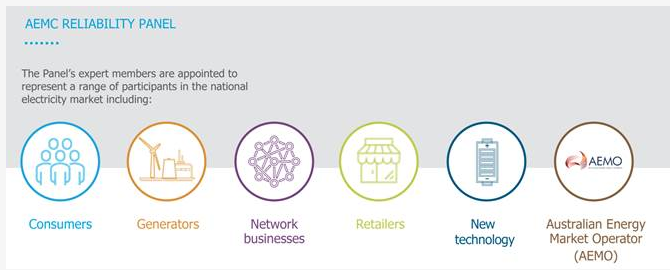
The Panel is comprised of members who represent a range of participants in the national electricity market, including consumer groups, generators, network businesses, retailers and the Australian Energy Market Operator (AEMO).
 

AEMC calling for approval of nominees to represent generators and market customers on the Reliability Panel

07 November 2019

The AEMC is seeking approval of nominees from generation businesses and market customers to join the Reliability Panel for the next three years. The Reliability Panel reviews and reports on the safety, security and reliability of the national electricity system and also sets a number of technical standards and guidelines. 

The Panel is comprised of members who represent a range of participants in the national electricity market, including consumer groups, generators, network businesses, new technology, retailers and the Australian Energy Market Operator. It is chaired by AEMC Commissioner Charles Popple.

In September 2019 the Commission invited registered generators and market customers to nominate candidates to represent them on the Panel. At the conclusion of that nomination process, five generators and two market customers had separately nominated candidates.

On 4 October 2019 we wrote to registered generators and market customers inviting them to approve one or more of the relevant nominees as their representative on the Panel. These participants had until 28 October 2019 to return their approval form to the AEMC. 

The National Electricity Rules require that the AEMC appoint a person to the Panel agreed to by at least one third in number of the relevant class of registered participants. None of the nominees for either the generator or market customer representatives received approval from one third of the relevant class of participants following the conclusion of the approval process.

The Commission is therefore required to undertake an additional approval round before it can appoint candidates as the market customer and generator representatives on the Panel. 

Registered generators and market customers will shortly be contacted with more information about the additional approval round. If you wish to update your organisation’s contact details for the Reliability Panel nominations, please send through the details to panel@aemc.gov.au.  

For more information contact Victoria Mollard, Acting Executive General Manager – Security and Reliability on (02) 8296 7872 or victoria.mollard@aemc.gov.au

Media: Bronwyn Rosser, Communications Specialist, 0423 280 341; bronwyn.rosser@aemc.gov.au

Thumbnail


Subscribe to Corporate